

review: MSR Groundhog Stakes
2012-07-26
Simply stated: these are the best stakes I've yet tried.
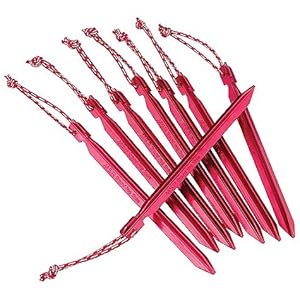
If you don't know, these are actually pretty well known in backpacking circles. It *seems* like something should be better, and yet nothing arises. I've looked for a titanium alternative, but they are hard to find and I always end up back at the aluminum groundhogs.
Q: So, why do I think they are so great?
A: Well, because they are the best tradeoff.
- They are strong enough that you can push them in with your heal, and not worry about bending them.
-
They hold well enough that you can pitch a tarp in sand with them, as long as it's not stormy, or in sandy loam if it is stormy. I've had them hold in ~50mph wind when stuck into turf (I twisted my ankle on top of a mountain on the AT), a hailstorm in Yosemite, etc.
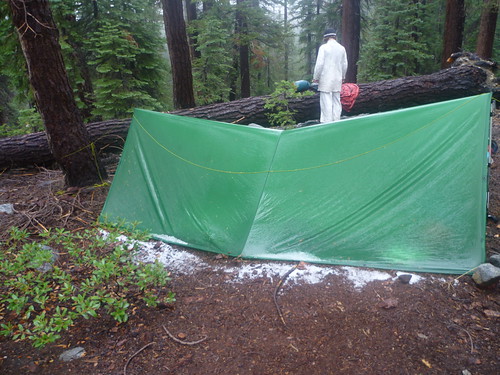
- They're the lightest thing with the two above properties
Q: Do they always work and always hold?
A: No, of course not, don't be ridiculous. For instance, they don't hold in sandy clay in a full downpour with no cover or rootstructure in the soil, and 40mph winds. Neither do they hold in soft-snow unless you deadman them (burry the stake sideways with the twine tied aroudn the middle). I've used them normally in shallow/stiff snow a couple of times and they worked fine.
Q: Why not these?
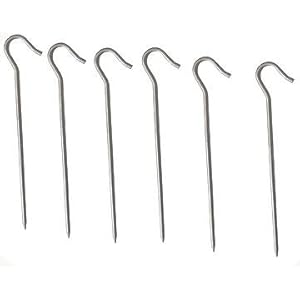
A: Because in practice I'd rather tie to bushes, rocks, and sticks. These are okay... but I don't trust these to hold any more than I trust a stick shoved in the ground. They bend on hard ground, they don't hold at all unless you're basically in peat. So why the heck would I bother carrying them? I did for a while... no thanks.
Q: How about these?
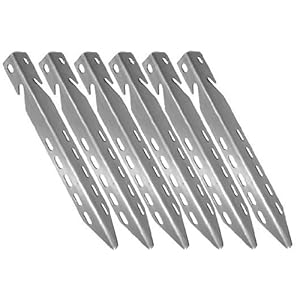
A: They snap in half, trying to get them to hold in sand in Joshua Tree I set rocks on them and they collapsed. The ones without the holes through them are a bit better, but still don't hold as well as the groundhogs - I currently use them for non-critical stakes. If you're gentle and a gram weenie, the ones without holes may be a good fit for you though.
Q: How about a large curved steel stake? (sadly, I can't find an image)
A: These are awesome, I might consider carrying these again even if I was the type to go up into the rockies carrying a nice big tent and set a base-camp for a long period of time. For "backpacking" though, as I think of it (that is, hiking every day, moving camp regularly, etc.) these are just WAY overkill.
Last notes
If you're a gear manufacturer, could you make some titanium groundhogs? PLEEASE!?FYI: make sure you get ones with the label/stamp. There are fakes
So, what are your favorite stakes?
Things I don't carry backpacking
2012-07-18
A lot of people post gear lists, but sometimes what's left out can be more interesting. Here's some stuff I don't tend to carry.

A GPS
A GPS needs batteries, needs the right maps loaded, needs to be able to get a lock, the batteries can run down... Mostly they're heavier, more expensive and more complicated then a map and compass, which you need to know how to use anyway as backup. Only once have I gotten disoriented enough that I felt lost and that was after I'd had a major nose bleed at altitude while bushwhacking. I'm pretty sure I could have backtracked from there without major issue, but luckily I was with Brewer, so I just made him navigate.In general having a good map, knowing what your backstops are and knowing how to orient yourself have always been enough for me. The only reason I can think of that I'd carry a GPS is if I ended up in a SAR group that used exact coordinates heavily.
Underwear
In civilization underwear makes a lot of sense. You change it daily so you don't have to wash your pants quite so often while still staying clean. That kind of breaks down when you're only washing all your clothing every two weeks.Don't get me wrong, for short trips I'll still wear it out of habit, but for a longer trip like the AT or JMT a bit more airflow seems healthier. On the AT I brought two pairs of shorts. I wore one during the day, and the other at night. It was probably overkill, but I didn't want to wear the same piece of clothing continuously for months on end and I didn't want to get my sleeping bag dirty. I could see carrying undies - especially boxers for the "night shorts", but for the AT I really enjoyed having a pair of shorts that was easy to clean and hard to stain for hiking in during my period.
TP and potty trowel
A sturdy stick can be a pretty effective digging implement. Likewise leaves, sticks, or rocks can do the wiping job pretty well. I really don't see the point carrying TP or a potty trowel, but if it's what matters to you then by all means take it along.Water Filter
Yup, filtered water tastes better. I've also yet to be on a group trip where someone didn't ask to borrow my iodine 'cause the pump took too long. I carry Polar Pure , which is sadly not sold anymore, and really love it. Besides the weight savings of the filter itself I find that I'm much more willing to stop and refill my water because it's so fast.What don't you carry?
Grass seeds and burs
2012-07-16
This is a little discussed topic in backpacking/outdoorsing, and yet one of the most annoying things you can run into on a trip. We've mentioned this in passing, but never addressed it directly, so here goes...
Grass seeds.
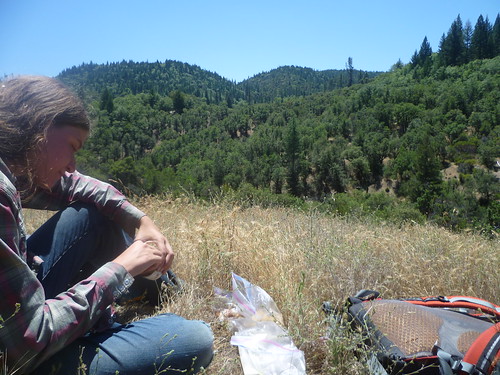
Though I've never had grass ruin a trip, it certainly can suck the fun away to constantly have your hair pulled or be getting stabbed in the feet.
To give an idea how important/annoying this can get, on a trip in PA I wore mesh racing flats, and I had to stop once every 1/2 hour to hour to pull grass seed out of my shoes for several days of a 9 day trip. If I neglected this I'd end up with nasty sores. One actually punctured Jess' skin and started working it's way into her foot. We got to calling wild oats our "nemesis" for some time. Since then I've stopped using mesh shoes, because it's just not worth it when grass seed rears it's head.
So, lets talk in a little more detail about why it's a problem.
2 obnoxious types
Sharp grass seed that will work it's way into everything and eventually stab you. e.g. wild oats:
- They are sharp enough to puncture things like sleeping pads, waterproof stuffsacks, etc.
- They work their way into fabrics (e.g. blankets and socks) and take forever to pick out.
- They work their way into your shoes and stab your feet, 'causing you to have to stop regularly to pull them out of your shoes.
Burs that will stick to *everything*:
- They stick in your leg hairs if you have them. This can get quite painful once your leg is nearly solid burs as they are going to be pulling continuously on basically every hair.
- They stick to your blankets and clothes and make them pretty uncomfortable
- They stick in your hair on your head and become impossible to remove without cutting.
Obviously problems with grass seed only arise if there's grass around, and some of the seeds are ripe. So it's a limited part of the year.
It's also much more likely to be an issue when you bushwhack, as you end up walking through tall grass more often. Our first run-in, as mentioned above, was on a 9-day trip in PA where we were supposedly on trail, but some trail was very faint and rarely traveled.
Mitigations
Going back to the problems I listed before, some mitigation techniques should immediately come to mind. Bear in mind that some grass seed will always get through your defenses, just like rain. And like rain life is better if you resign yourself to some getting through, but keeping the levels down a little can make things a lot more comfy.
-
Wear somewhat puncture resistant and non-fuzzy clothing:
- Gators to cover socks.
- Nylon, canvas, or similar pants of any form (rain or wind pants work).
- Leather or otherwise non-mesh shoes (huaraches work too).
-
Don't lay down any loose woven fabrics:
- Tramp down the grass as much as you can before lying down to sleep.
- A ground-cloth or bivy can help keep it out of your blanket/bag.
-
Things will get punctured:
- Don't use your inflatable pad.
- Recognize your groundcloth will get tiny holes in it.
- Don't wear your waterproof socks.
The mitigations are super simple and easy... you just have to realize when you'll need them. I feel like I forget almost every year and have to be reminded by one uncomfortable trip.
As a slightly surprising note, Merrell tough gloves for instance, despite being leather, will still get a non-trivial amount of grass-seed in them (way way less than mesh though). They lack a gusset on the tongue and the laces come down farther than most gators. As a result grass seed slides down between the tongue and inside of the shoe. This isn't terrible, but does mean every couple of hours of hiking in grass you might have to pick some out.
At least it'll make you feel better ;-)
If you have lots of grass you can make yourself a comfy bed out of just that! Gather a nice big armload. Spread half of it on the ground vertically relative to how you plan to sleep. Now spread the other half over that horizontally. Now you have a comfy mattress!
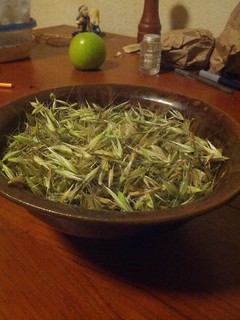
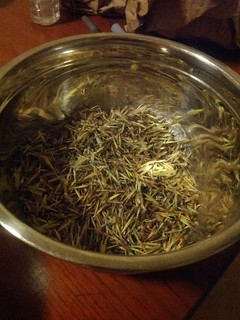
Wild oats, one of the worst offenders, are edible. So you can get them back! It also just makes me less annoyed when I know that this copious resource for annoyance is a copious resource for food as well. We're still working on how to process and eat them, I have some I'm experimenting with now, stay tuned.
Unprocessed:
|
Winnowed:
|
Got any grass seed stories to share? I'm curious how common a problem this really is for other people. It sure has hit us hard a few times. What do you do to mitigate problems with grass seed?
Backpacking without backpacks
2012-07-09
This weekend I biked up to Stanborn County Park, hiked ~13 miles, camped out and biked home without a sleeping bag or backpack. Evan kept my company. This was his second backpacking trip.
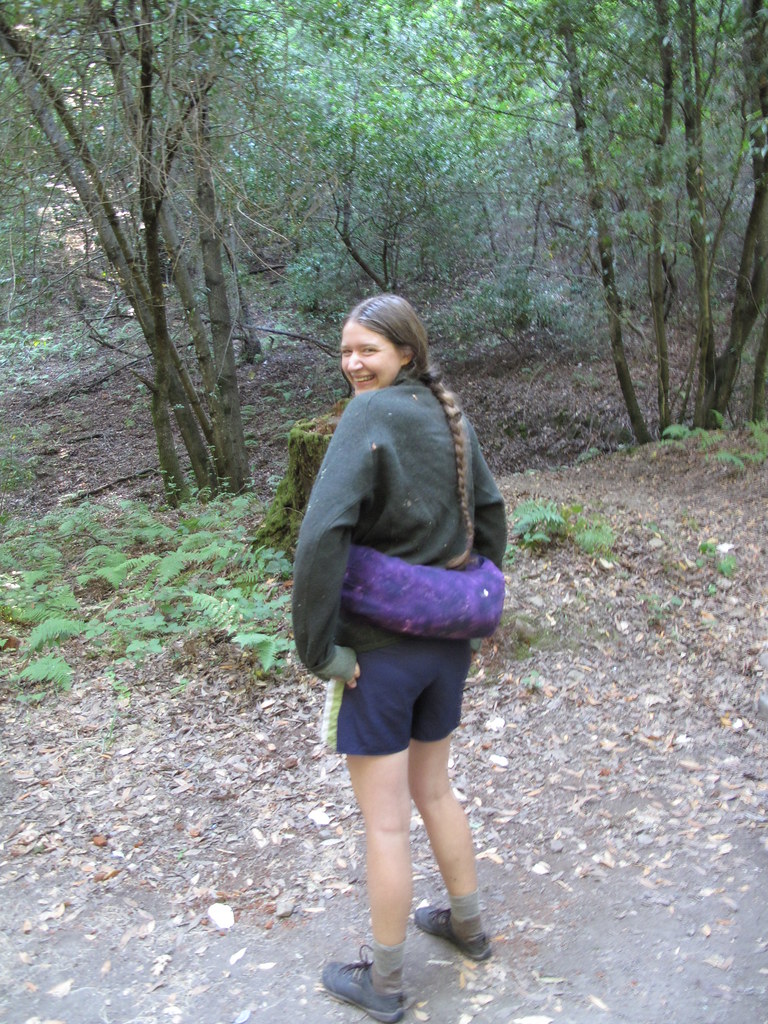
Me and all my gear
The bike ride up Saturday morning was fairly uneventful. We only got lost a few times and made it the 15 miles up to the edge of the park around lunch time. It was really hot by the time we got to the edge of the park so we elected to ditch the bikes and hike the rest of the way to the main entrance instead of biking all the way in as originally planned.
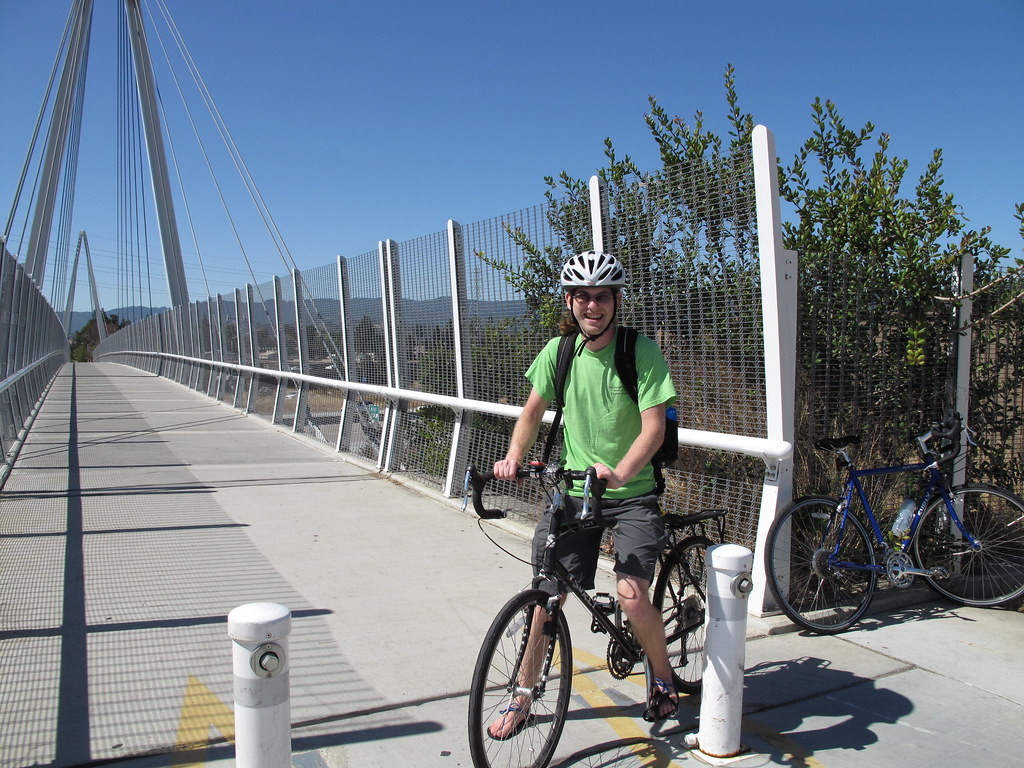
Evan on the way to the campsite
The walk in was a blast. The trails on that side of the road aren't maintained, so we got to play on the ruins of dams and bridges, rock hop, and generally navigate by intuition. Eventually the "trail" we were following dead ended by a fence so I took Evan on his first unplanned bushwhacking expedition through a steep gorge to the road. It was just a short walk from there to headquarters where we secured a campsite and considered our next move. (I know dispersed camping is more fun, but I can only get so far on a bike.)
Since it was hot we decided to ditch some of our gear before going out on a hike. I left behind the blanket, sweater and hat while Evan left everything but his water bottle and a map. We had a fun walk sharing navigation and plant knowledge before heading back to camp for dinner.
I had instant split pea soup, but no stove. The idea was to finally try making cold backpacking food. I'd read the idea on Gossamer Gear's site years ago, but hadn't actually left the stove at home before. It worked perfectly. I put in some water, closed the ziplock bag, mushed it around and let it sit a while and then ate it. It'd been a warm enough day that eating it cold didn't really feel like a tribulation.
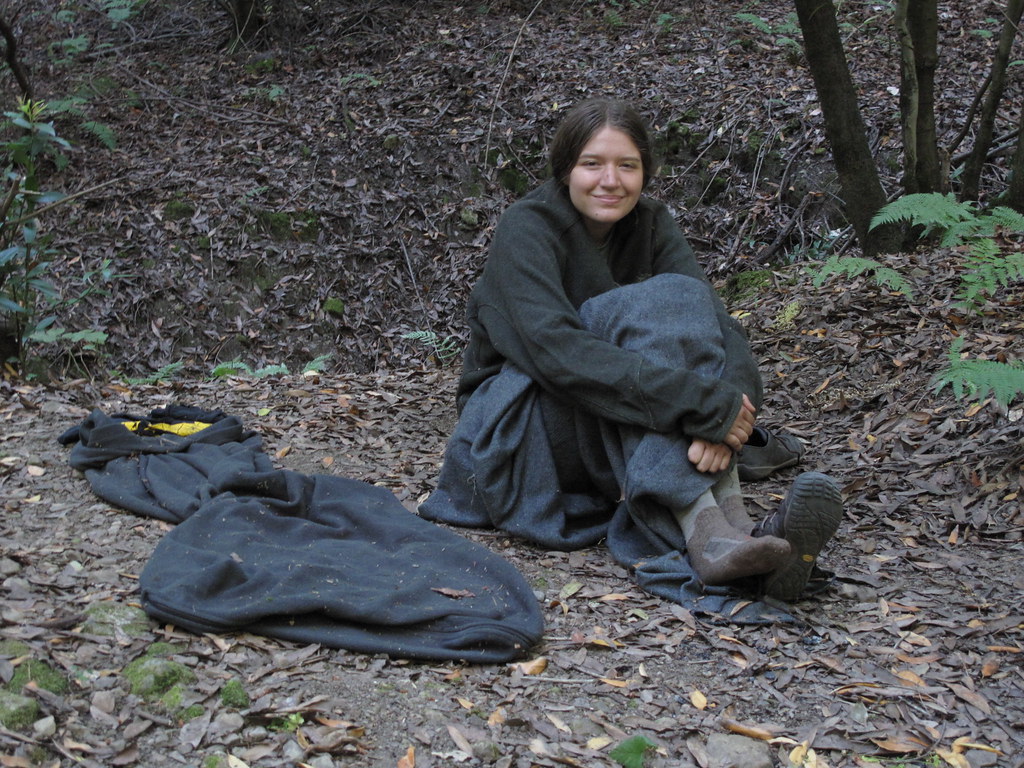
Getting dressed in the morning
Eventually it was time for bed. I wrapped one side of me in the sarong and then the other in the wool blanket. The wool blanked actually reached most of the way around, but this way the sarong blocked the drafty spot. Evan climbed into his fleece liner and we both settled in to sleep. It was a bit hard to fall asleep because the neighbors were a bit loud at first, but eventually we managed. I woke up part way through the night covered in sweat. I was fine walking to and from the bathrooms barefoot without a sweater and then curled back up into my super toasty bed. The only issue I had was that I didn't want to shift too much in my sleep and scatter the blankets everywhere so I kept waking up to roll over.
Evan on the other hand got a bit uncomfortable. He found sleeping on his front or back to be chilly, and his side to be warm but a bit uncomfy. I probably should have lent him my sleeping pad to bring, but he slept pretty well anyway. Weather reports say the low was a balmy 58 degrees.
In the morning we had some gorp, wandered around the park a little bit and then rode home on our bikes. All around a pretty successful trip.
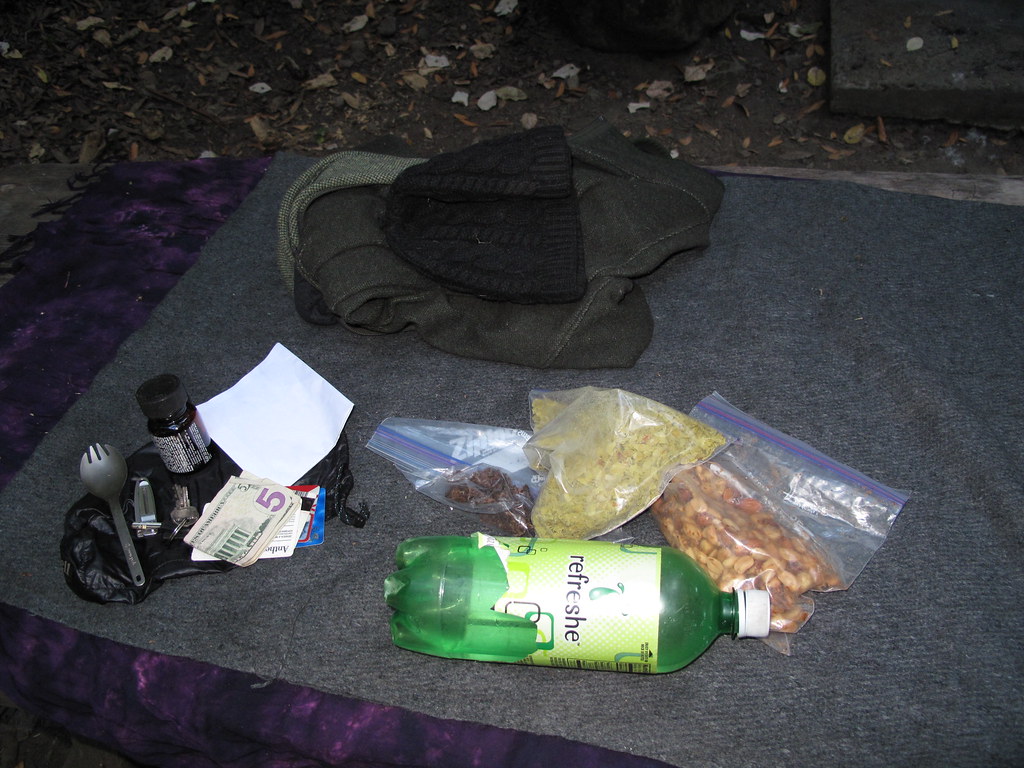
Here's the full list of what I brought:
- Sarong (because the blanket itself was too bulky to tie around my waist)
- Wool blanket (for sleeping)
- Water bottle
- Food (gorp, jerky, split pea soup mix)
- Sweater (Didn't need it, hot to carry. Shouldn't have brought)
- Warm hat (Didn't need. Easy to carry.)
- Spork
- Knife
- Keys
- Cards/Cash
- Maps
- Carry bag
- Iodine (Water treatment)
- Synthetic shirt
- Buckskin bra
- Synthetic shorts
- Cotton undies
- Bridgedale socks
- Merrill Glove shoes
- Salt lick (for electrolytes. Stashed in my pocket)
- Button compass (for testing sense of direction. In pocket)
All in all the gear worked surprisingly well. Having to stop and undo the "pack" to get at the water bottle was a little bit annoying, but I didn't find myself wanting anything I didn't have. Wearing the sarong + wool blanket tied around my waist was very comfy as the blanket acted like a padded hip belt. It was, however, very warm to have all that wool around my waist. I wish I'd left the sweater at home.
To address the heat issue I want to try carrying everything in the sarong, but switch out the wool blanket for my silk bivy. I don't think it'll be as warm, but the wool blanket was much warmer then I needed for summer weather anyway.
How to make Jerky
2012-06-29
I've been making a lot of jerky recently without a dehydrator, and it's super easy. The basic concept with jerky is that you're taking a lean meat, cutting it into thin strips and then drying it out. You want a lean meat so that the fat doesn't go rancid on you. You can add flavoring, but that's mostly a taste thing.
So first step is to pick out the meat. Flank steak is the easiest thing to buy. Sheep jerky is amazing. I bet goat would be even better. As stated before the biggest thing is that you don't want any fat marbled into the cut. (Also cubed is a pain in the butt to slice) Then take a very sharp knife and cut against the grain to make the thinnest slices you can manage. Some people suggest freezing it slightly before hand to make this easier, but I prefer to do it with fresh meat.
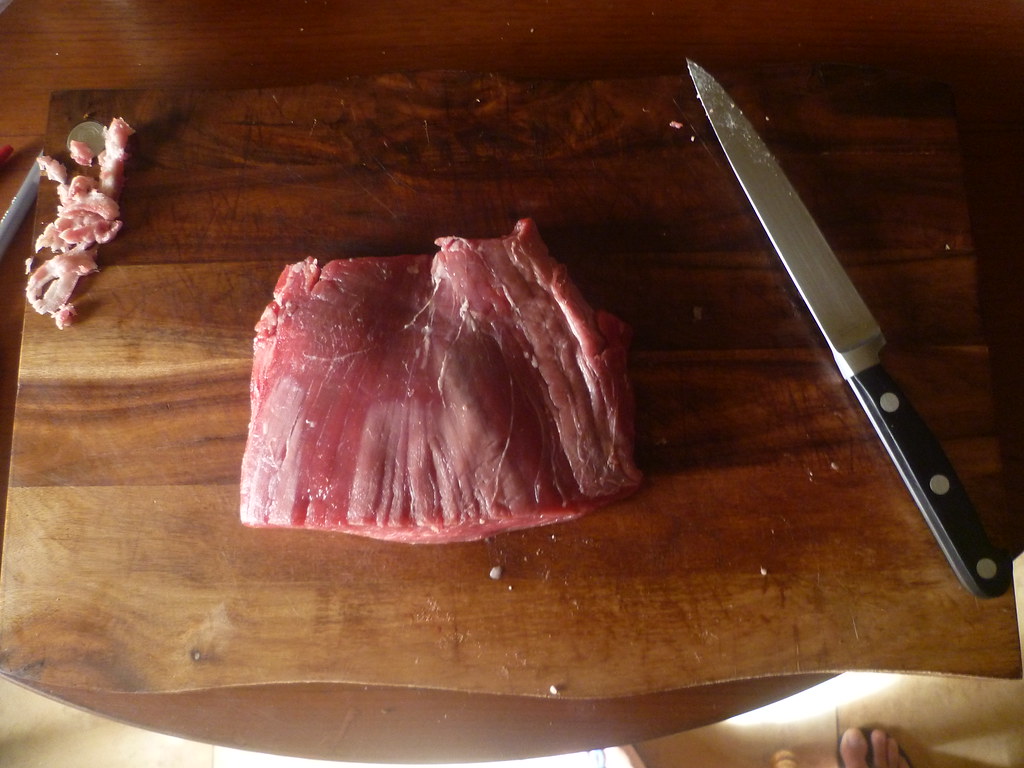
If you want to marinate it now's the time. I marinated my last batch using this recipe (without the liquid smoke), but it had too much Worcestershire sauce in it for my tastes. If you marinade let it soak for a few hours, then pull it out, dry it off with a towel and continue from there. In the past I've just sprinkled soy sauce, salt, pepper, and a little hot pepper on the meat strips. It's a bit blander, but way easier.
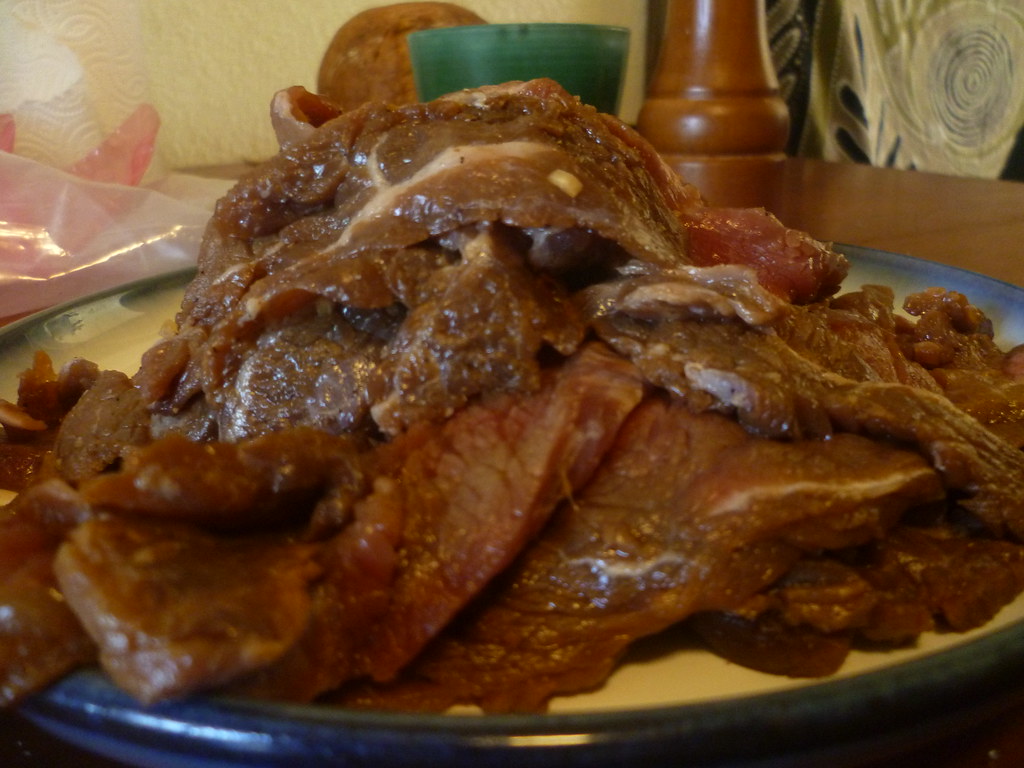
Okay! Hard part over, now it's just time to hang it up in the backyard to dry. Any dry, warm day should do it. I kind of squish any thick pieces a little thinner as I'm hanging it up, but I don't know how much it matters.
I make sure to pick a sunny spot where the sun hits it full on for the initial part of the drying process. Later on it doesn't mater, but when the meat's wet the flies will be interested in it. Once a crust forms on the outside they can't get at it. I haven't hand any problems with flies ruining the jerky though - only with the neighbor's dog stealing a few pieces.
How long the jerky will have to dry depends on your preferences and your climate. Generally I dry it for two days in the sun (I have to take it in at night so the sprinklers don't get it wet), though this last time I put it up on the balcony after the first day and just left it for three days. I like mine dried to the point where it will snap if you bend it.
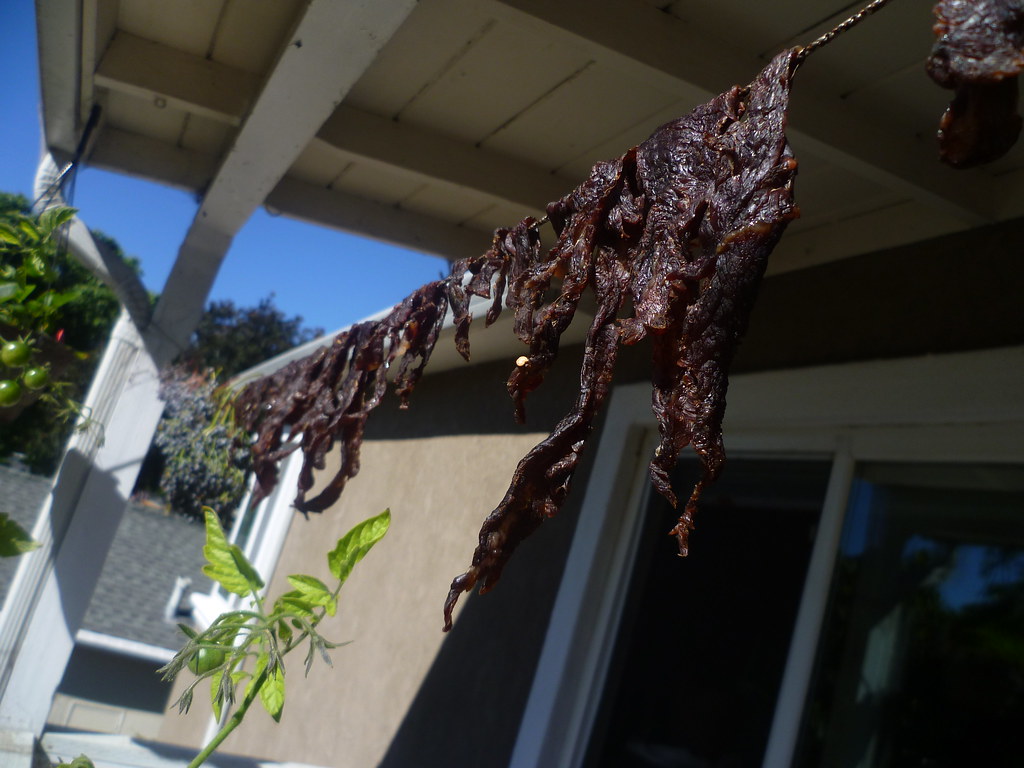
That's it! I tend to store mine tied up in a bandana, but a paper bag should also work fine. If your climate is particularly cold or humid this might not work as well, but it works wonders even in May in California.
Notes:
- Beef in particular seems to get a slightly sour flavor partway through the aging process. If you let it age longer (at least a month or two) it appears to go away again, but this is probably why people flavor their jerky so much.
- These pictures are all of about a pound of flank steak. More are here