

Tips for spinning up fire
2012-06-07
We're not experts yet, but we've gathered quite a lot of tricks from various people, and we have succeeded in spinning up a few fires now, so I wanted to share some of those tips.
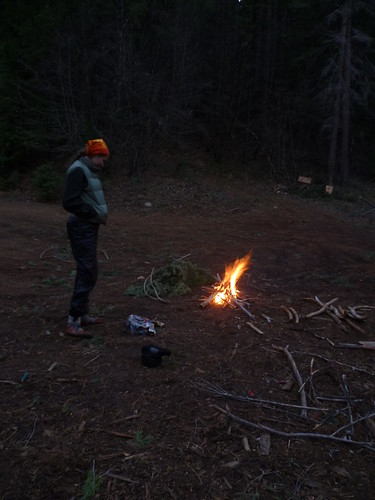 Regardless of other details what we're talking about here is starting a fire by creating heat via spinning a stick against a board. As you spin the stick you create a fine powder, the goal is to get this powder to compact into a nice little block right where all the heat is, so that that block of powder will ignite (at this point smoke will pour out if it, even once you stop, blowing on it lightly will show a bit of hot red). You then take this block, drop it into a tinder bundle, and blow that very slightly glowing little pack of powder into igniting the tinder around it. Now it's just a matter of basic fire skill to turn that burning tinder into a full fledged fire.
The stick that you spin is called a "drill" or sometimes "spindle" and the board you spin it against is called a "hearth" or "hearth-board".
Selecting wood type
So, How do you make this happen? You need to create a powder, usually you want this powder to come from the hearth-board. This means you usually want the hearth board to be a bit softer than the drill. Here's some of the easier woods to use:- Hand Drills:
- Seep willow (tried)
- Thick walled elderberry (seen it used)
- Buckeye sucker (tried)
- Sojaro rib (seen it used)
- Ceder (tried)
- Bow Drills:
- Sotol (tried)
- Yucca stalk or root (tried)
- Seep willow (tried)
- Hearths:
- Sojaro cactus root or rib (tried)
- ceder (tried)
- buckeye (tried)
- cottonwood root (tried)
Selecting materials
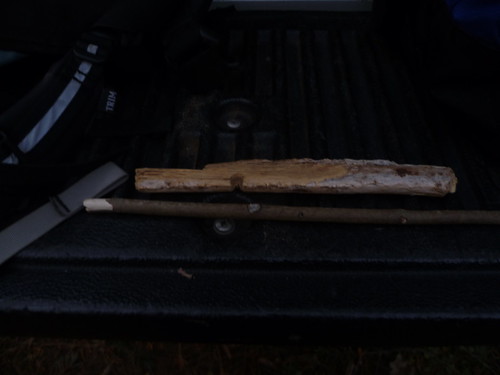
Drill: If you're making a bowdrill, grab something around the size of your thumb or a bit larger. It's easiest if it's straight for 6-9 inches, cut it to this around length. You want it to come ~1/2 of the way up your lower leg. If you're using a handdrill grab something the size of your pinky or a bit smaller. (I'm 5' 6" and have large hands, but midsized fingers - adjust as needed for other sized hands). It should be at least 2 ft long.
Hearth: I'd aim for a minimum width of about twice the diameter of the drill you're using. You'll want it to be a good 8" long or more, so you have some space to put your foot on one end and drill on the other. Note that you'll need to flatten the hearth on BOTH sides,. Flattening the bottom as well as top is really important because if you can't get it to sit totally stably you'll repeatedly disturb the powder you've built up losing both the heat and the powder.
Bowdrill specific stuff:
Twine: need something thick and not too smooth that will grip the spindle. If it's too slick it will slide on the spindle cutting into it.
knuckle: It makes absolutely no difference what you use for this, it just shouldn't have much friction. A rock with a dent in it is great. If your rock doesn't have a dent you can make one given an hour or so of pecking. The knuckle-bone from a ruminant is also a popular choice and a bit easier. Supposedly roots or knots from some trees work well. If worse comes to worse you can just use another chunk of wood, you'll just want to really sharpen the spindle on this end to reduce friction.
Making components
You have all your materials. Now to make them into the components you need - note that you'll probably reshape several times again while trying to spin it up as you realize things are slightly off Drill: Now sharpen the bottom point of the drill a little. You want a pretty shallow point, at probably 140 degrees or shallower. Jess says sharper points work for the earlier steps, so as with all of this stuff experiment. For bowdrill sharpen the other end at a much steeper angle, something that will help it spin smoothly in the knuckle. You can also take a little oil from behind your ear or the side of your nose and rub that onto that end of the spindle. Do NOT put this on the bottom! we want friction and thus heat at that end!Hearth: Take the hearth board and place your spindle on the board just a bit in from the edge. You probably want the edge of the spindle about 1/8" or so from the edge of the board. Wherever this places the tip of your spindle, drill a small hole with your pocket knife or stone blade.
Bowdrill technique:
Bow: For a bowdrill you'll want to make a bow with the twine. Use a clove hitch to tie the twine to the drill, this will let you adjust tension, if it slides too much you can use a constrictor hitch or something else instead, a timber hitch might also be a good choice.Take the drill and push it against the bow-string. With a bit of a spinning motion you should be able to wrap the twine around the spindle one round. The twine should be taught at this point, but not SUPER tight. Note that if it's just a touch loose that'll be *okay* in another minute.
Stance: If you are right handed get down on your right knee and place your left foot on the hearth board with some weight on it. Get yourself up and *over* the hearth. Take the knuckle with your left hand and lock it up under your left shinbone (arm coming around from the outside). This will keep it stable so the spindle doesn't wobble all over the place.
Place the drill in the hole with the whole setup and start it spinning with the bow. Do this smoothly and slowly, don't worry about speed at all. The spindle will no doubt shoot away from you a good 5 feet in no-time. Go get it and try again. Be patient and keep reshaping things. You may need to tweak the shape of the tip, the hole in the board, the back of the board, or maybe dig a bit in the dirt or similar to get the hearth to be really stable and the drill to stay in there. Note that if you are rocking around as you move your spindle will end up shooting out. If your twine is sliding on the spindle you have more friction in the spindle than you do in the twine against the spindle. You can increase the twine friction by holding it so you push a bit on the twine with your right hand. If the spindle isn't spinning check your knuckle, make sure the spindle is straight, oil the top again with nose or ear wax/oil. Use the bow in *long* strokes. Every time you switch direction you stop, which will let it cool down, so a long stroke will involve a lot less work. Keep at it reshaping and tweaking until everything is comfortable and smooth. If you can't get it check your stance from the last paragraph - it really really matters, lock that hand under the shinbone.
Alright, so you've got the right wood, you've got the right sizes and shapes, you've got it spinning nicely, and if it's spinning nicely then by now incidentally you've burned a nice circle into the hearth board. The next step then is to make the powder we need. Take a knife and cut a notch into the hearth right next to the hole you burned. There's a lot of debate about this, so try various differences, but cut a narrow notch going almost but not quite half-way across the hole you burned. Several people have told me to make this notch wider at the bottom than the top - I suspect though that this only matters for hand-drill (where the drill is thin), not so much for bow-drill where you have plenty of space.
If your spindle is pointy, cut the tip of the point off (so it will rub on the edges more instead of sitting on the tip. The wood is moving faster at the edges). If the wood of the spindle is starting to fire-harden and shine, cut it off and reshape the tip again. If you had any issue at all with fire-hardening, take a pinch of gritty soil (preferably silt) and drop it in the hole in the hearth, this will let you wear off the shiny layer as you go.
Now get a surface of some kind. A rock or a leaf works well. Carefully place this under the hearth board where the notch is. This will catch the dust and let it build up in the notch into a packed pile ready to ignite. Make sure you get the hearth-board stable again so that it doesn't rock at ALL. This is *really really* important. If your hearth moves, you basically start over (you will start over a few times, but keep that in mind).
Get back in the stance and start back at it with slow long even strokes, As you go you should be building up powder in the notch. If it squeaks push a touch harder. Keep it easy and slow, but try not to stop. That powder is already warm, and if you lose that warmth you have to get it back, why do that? If you take off now though you'll probably wear out before you have a fire, or more likely not move smoothly enough and all your drill will go flying again. Only speed up if you go for a couple of minutes and are getting no powder, no smoke, no burn-in, and no squeak.
Once you see you have good powder buildup, it should mostly fill the notch, try and speed up a little. Keep it smooth and even with long strokes, but try and get a little more speed without losing that smoothness. Think about form not about power. About now you'll start to see smoke coming from the board. That's AWESOME! Don't STOP! Also, don't breath out really deeply looking at the board, you'll blow all the powder away! Keep breathing, and keep it going, don't speed up, don't go crazy, don't use up all your energy. Now you've got a continuous stream of smoke coming out the whole time. Keep going! At some point you'll have a significant amount of smoke coming out and hopefully you will even start to see red.
Once you see a bit of red in the powder... stop. Very very carefully take the board and lift it off your catching surface. flick the board with your finger to get it to drop the cinder you've made.
Take the cinder and drop it in the center of the best tinder bundle you could possibly have gathered (which I'm sure you were meticulous about with wonderful fluff in the center and maybe some good dry grass or shredded dry inner cambium etc.) Take the tinder bundle and hold it *tight*. You want to make sure a decent amount of material is touching the cinder in the middle. It should be just starting to smoke. Blow on it very lightly but with a thin stream of air. As more smoke comes out blow harder on it (still with the thin stream). At some point you'll start to see flames, you may want to put it down somewhere now before you burn yourself :). CONGRATULATIONS, you've just made fire from nothing but some wood and twine!
If you fail (and you will, if not now than later), don't throw it all away. That powder is a damned good start. If your last hole is going to wear through make a new one, and stick the old powder into the new notch yourself. This may save you a lot of extra work. Go back to all the checks you did before, check your technique, make it smooth and comfortable.
Handdrill technique
Hand drill is all of the same concepts, except now you don't get the mechanical advantage that the bow gave you. Why would someone do this you ask? With bowdrill you need a bow, you need twine, and you need a knuckle. That's a lot of extra complexity. Twine isn't always easy to make everywhere you go. A hand-drill requires 2 sticks, and that's all.A few tips for handdrills though.
- Before you start, try clapping your hands until they are both slightly red. This sounds silly, but many find that it helps stave off blisters... others find it makes no difference. Personally it seems to work for me.
- you'll want to put the skinny end on the bottom, DON'T! The reason we're using a skinny drill is actually a matter of gear ratios basically, you want your hand on the skinniest part of the drill, as the same motion will then move the wider part of the drill farther.
- As you spin the drill notice the downforce you create on the spindle. You'll need quite a bit of pressure. If you focus on pushing down your hands will slide down the stick. Focus on form and push *in* pretty hard, this will let you slide downwards less for the same downwards force. Use as much of your hand as you can, as again this is less work. Some people find they can do it with just their palms, but just like the longer stroke with the bow-drill, you get more cooling time this way. Note that the bottom of the palm continuing into the pinky is the easiest place for most people to get the needed friction ('cause of the muscle structure there).
- Finding a sufficiently straight stick of the right wood is extremely difficult in modern times. Natives used to coppice buckeye and other plants to get straighter sticks, but we don't do that these days. So, find something relatively straight, preferably with a fairly simple bend (not many small bends). If you have a fire already (it's not like you're trying to start one or anything :P) hold the spindle over the fire (preferably coals) and warm it up. With it pretty warm try bending the wood straight. Keep bending and warming. Surprisingly the wood will actually straighten this way.
In closing
One last note for all of this. Don't rush. Spend the time to get the right materials, this makes all the difference. Spend the time to flatten the hearth properly. Spend the time to find a straight spindle, and straighten it more if you can. Make sure to get a spindle that's long enough in either case. Take all the little knobs off it so you can work it smoothly and not hurt your hands. Keep trying and keep experimenting.The reality of UrSacks
2012-05-23
There's a lot of FUD about the UrSacks. The reality is pretty hard to dig up. So, I wanted to post something with the actual *facts*.
Jess recently found this:
http://www.ca9.uscourts.gov/datastore/opinions/2011/05/09/09-17152.pdf
This paints a rather strikingly different picture than UrSack's website:
http://www.ursack.com/ursack-update.htm
It's a fascinating read, and if you're upset about where UrSack's are allowed I highly recommend reading it. This paints a very different picture though of why the few places that don't accept them don't.
For backpackers like Jess and myself, a very low failure rate is acceptable. We're usually far in the backcountry where bears are rarely problematic, only rarely camping in established campsites. So we rarely have issues with bears anyway.
Additionally, we've personally seen one of our Ursacks get chewed on, and seen 2 others that have been chewed on. All of these survived with no issue, though in one case their olive oil was punctured (annoying for sure, but they still had their food, and the bear didn't). Note that in both these cases bears could be scared off easily, which is not true everywhere.
I should add, I originally purchased an aluminum liner for my UrSack. It was so annoying that I never ever did actually use it. The only reason to use it is for the rare places that require it - which is basically none now.
Remember that the UrSack isn't just an alternative to canisters, it's also an alternative to sleeping on your food, or bear-bagging. If you're bad at throwing rocks, it can easily save an hour in the evening. If there are no good limbs around, or the bears there know about the PCT method, or you're not sufficiently skilled at bearbagging, or you're too lazy to bearbag in the first place, it still works well, and at about the same weight as the rope needed to bearbag.
For us, we use UrSacks instead of (or in bad bear country even in addition to) bearbagging. This is super handy in alpine areas as it also discourages chipmunks, mice and coons. For the rare cases where the UrSacks are disallowed, I own a crappy canister that I loan out to friends. You can also buy one of the super-light ones if you really care.
Pay your money, take your choice. But those are the facts. Have fun, be safe, and please don't feed the bears.
HYOH.
Jane: The Lift!
2012-04-24
The LIFT
As discussed previously, our Tacoma (Jane) is quite capable offroad, but the stock ride-height is a significant hindrance. With that in mind I purchased a lift-kit quite some time ago, but hadn't gotten around to installing it... well, I finally did.
So, I've now completed install of 3" lift on the back and 2" on the front. I've yet to test it out on trail. I did the install myself with a bit of help from Jess.
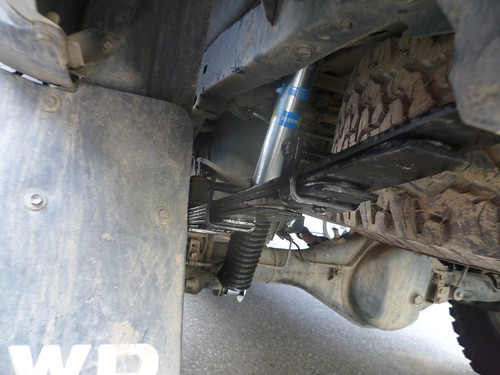 I installed an All-Pro rear lift-kit. The packs are 7-leaf so better than new stock... and WAY better than old completely blown springs ;-). The dampers are Bilstein.
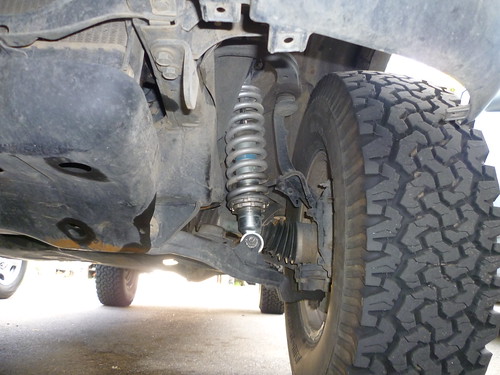 I forget what the front is. Donahoe's aren't available anymore, but it's an isomorphic substitute. I seem to recall they're also Bilstein. Adjustable ride-height from 0" to 3" lift over stock. These have been installed for some time, I just cranked them up after installing the new leafs. Initially I cranked them up WAY too high, it turned out moving the ring 3/4" up was enough to get 2" of lift. I discovered this by 1/4" increment adjustments, consisting of jack truck, remove wheels, adjust, mount wheels, lower truck, look measure. It was mildly frustrating :D. After doing this I took it in for a professional alignment. It was slightly off before so it tracks better than it has since we've owned it.
The truck handles WAY better even on-road now. It used to be the rear-end would skip if you cornered hard, causing sudden overstear any time you hit a bump, not it stays glued to the road. I intentionally lifted the back more than the front. There are three reasons for this.
First: The 2002 Tacoma is an independent double-wishbone spring-over system on the front. The stock equipment has ~3" of down-travel or "droop" on the front suspension. This means that if you lift the truck 3", you're at the limit of the original equipment, and have no droop left. This leaves the truck with crappy ride-quality, the wheels leave the ground at the drop of a hat and skip easily, and on top of that it's at the limit of what the alignment equipment and CV joints can handle.
Second: Visually I really hate "saggy butts" on cars, and so does Jess. It looks like you blew your rear springs and didn't bother to do anything about it. I wanted the front to ride at least level with the back even if we load up the back with gear for a trip, for example.
third: It turns out 2.5" lift-kits for the rear were twice the cost :P. So, now I can't wait to get her out on the trails again! Our oversized tires aren't hitting the frame now with the lift installed, so the turning radius is back to stock. With that plus the lift the rear is 3.5" higher, and the front ~2.5". This means the breakover angle is much much better, so finally I won't bottom out going over bumps. It should also help the entrance and exit angles as well, thus helping prevent the situation where we were stuck on the front bumper.
Pictures: http://www.flickr.com/photos/smalladventures/sets/72157629811378533/
Jane: More offroading
2012-04-24
So, a friend of mine was coming into town. We've been chatting for some time about offroading in general, talking about how to build out our rigs etc. He's got a samurai he's been working on. I've got Jane, the Tacoma I share with Jess.
Well, I figured while he was out here I had to get him out on some trails in Jane for a bit of fun. So, we grabbed another friend of ours, and the 3 of us trucked off to Hollister with way more food than we needed, and some spare gas for the truck as well. Here's some of what resulted:
Truck Porn!
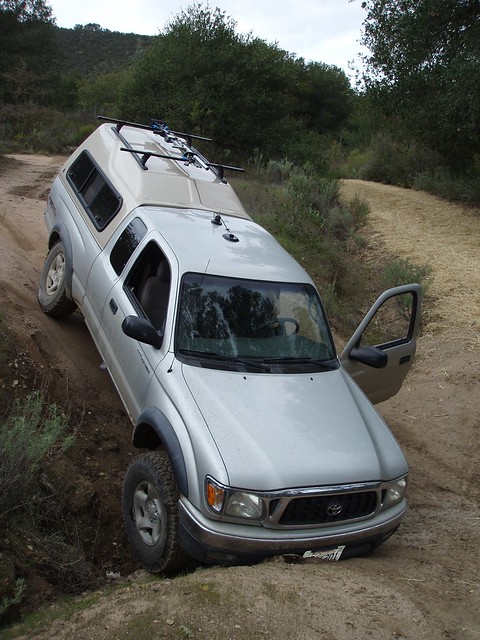
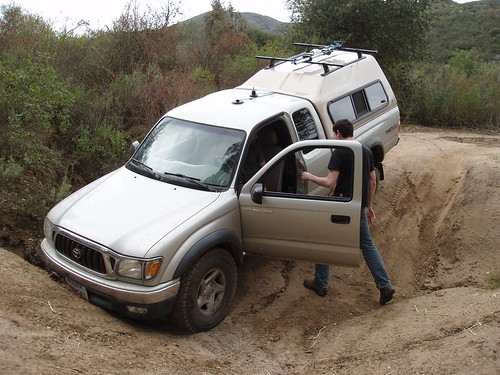
My friend was driving at the time, and I was directing. He had the truck looking a bit precarious, I was worried he would roll it so I yelled to get off the brake. I hadn't told him which direction to go yet though, I needed him to spin the wheel left but hadn't said so. Well... he didn't and she rolled down into the position above. Ooops!
As luck would have it, that bumper is much tougher than it looks (yay Tacomas!) We had enough traction and I backed her up just a foot or so, spun the wheel left and she rolled right out.
That was probably the most exciting moment. We were having too much fun to get shots of the best parts, like getting lost on black trails for a while, driving through a giant puddle and throwing some water in through the window, or bottoming out going over some concrete pipes. But, here's a few shots we did get.
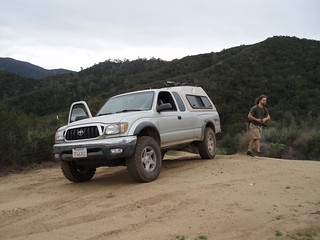 On the top of the hill! (The trail up was a black)
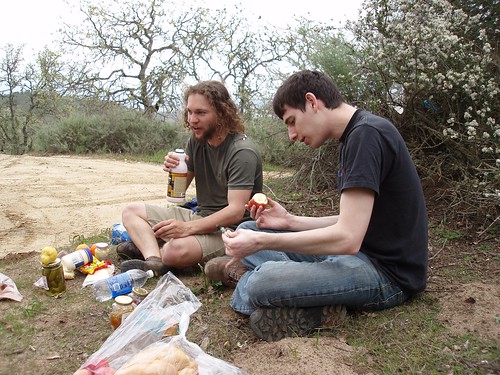 Stopping for a snack.
 Yup, my shuffle technique is terrible.
At this point the truck was running 265/75 R16 tires, but is otherwise stock. I replaced the transmission fluid just before this trip, and I did the plugs a bit before that.
How'd she do!
The I4 is... interesting sometimes. When you're on a hill and trying to get her over a rock, it's really hard to get enough torque, even in low range, and not get her moving too fast. I got some practice with my heal-toe technique, and I'm practicing a lot in normal driving via trying to learn to double-clutch. In the end the i4 is *enough*, I just have to be a better driver to use it.
Although Jane *could* do blacks and was surprisingly able on all of the trails, we nearly high-centered her several times, I was playing some interesting games at one point sliding down a hill slightly crooked trying to keep her out of the ruts. We were also running the tires overinflated to maximize clearance, but this hurt traction a lot. It worked, but she needs a lift.
Most of these pictures are courtesy of Orie. Who notable doesn't show up in any :P. Here's the rest Pictures: http://www.flickr.com/photos/smalladventures/sets/72157629811341461/Review: Merrell Tough Glove
2012-03-12
I've had these shoes for 7 months now.
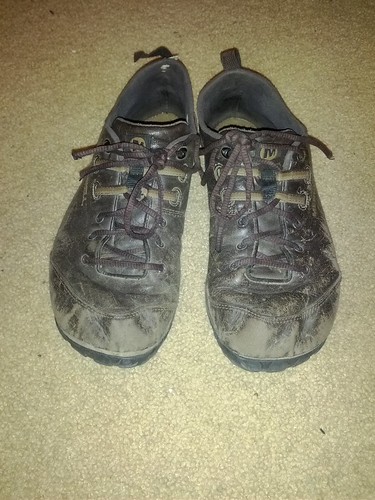
Here's a new pair:
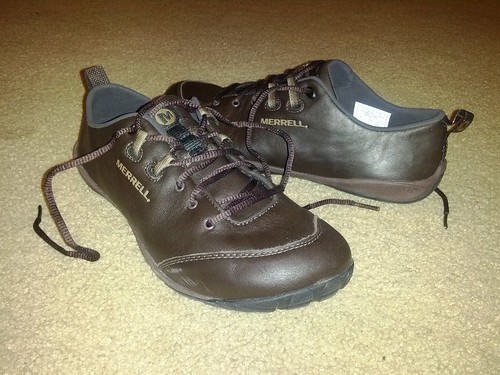
Since purchasing these

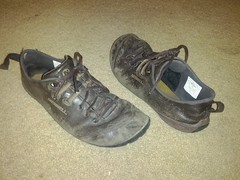
In any case, this is some pretty serious wear. I recently wore through the outer sole of the right shoe into the midsole, and so felt it was time for a review. For comparison, in the past I've done this in 2 months to an entirely reasonable pair of shoes, in more recent years it's taken me 3-4 months for my primary shoe. Translation: these shoes don't have wear problems.
I currently use these for all of my running, walking, and backpacking, excepting one special case for which they simply are not suitable, which I'll explain shortly. As someone who's wanted a simple, flat thin and flexible soled, leather shoe for years, I have to say this is the single best shoe I've tried by an order of magnitude. This shoe has kept me buying shoes instead of making my own (for good or for ill :P).
Before we dive into the details, a few quick notes. The Merrell Glove was designed as a competitor to the Vibram 5-fingers. It DOES have a slightly padded midsole. It is shoe shaped. It has an unusually large and widely shaped toe-box so your toes can spread kindof like 5-fingers or huaraches, but it doesn't quite achieve the same affect. To a barefoot walker it providers arch-support because it laces tightly around the foot, but no normal-shoe wearer would say it has arch-support.
In other words, the Merrell Glove is basically half-way between huaraches or 5-fingers, and a "normal" shoe. If you loved the old puma trail racers, but thought they were a bit too much shoe, or a bit too weird shaped a sole, these are the shoes for you.
Awesome things:
-
Super flexible: In the picture I'm applying very little pressure.
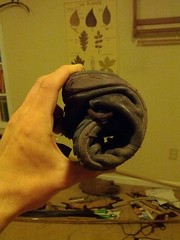
-
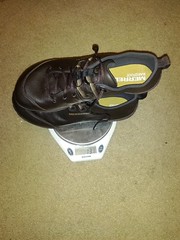
Super light: 13 3/4 ounces for the pair. Yes, you minimal shoe weenies might call that heavy, but remember, these are LEATHER. Jess' gillies she made herself weigh 1 lb 3/8 ounce, that's with no rubber sole.
- Leather: This is hard to express to people who haven't had trouble, but grass seed is an evil menace to us hikers. If you hike rarely traveled trails, or bushwhack across fields in the lowlands in the right season, then you'll hit this stuff. If you are wearing mesh shoes you'll find hundreds of seeds bristling out of your shoe, slowly worming their way in to stab your foot. If you don't do something about them they will stab your foot, and then work their way into THAT too! Because of several trips where I had to take off my shoes every 2 miles and spend 10 minutes pulling seeds to keep them out of my feet I've become a huge proponent of non-grass-permeable shoes. Leather breathes, and can also be made very water-resistant (I mean, usefully water-resistant, not just afraid of water) with a wax treatment. So it's my and Jess' preferred material.
-
Tough: I bushwhack, I run, I do parkour sometimes, I rock hop, I slide down hillsides regularly, I'm VERY hard on my shoes. I get tired of replacing them, and I need to trust them for a trip. I once wore a brand new pair of street racing shoes on a trip, and destroyed them in just 9 days. I threw them out when I got home. Optimally a shoe should wear out everywhere at once. If you look at the picture below, you can see that the top of the heal cup on my shoe has been stitched back together. That occurred within a week or two of wearing through the sole. The sole is also coming unglued, but the leather itself hasn't torn or cracked anywhere, thanks ironically to it's thinness and flexibility.
- Good traction: As just mentioned, I bushwhack, rock-hop, and slide down hills. I rock-hop in pouring rain if that's what's going on. I cross streams dynamically usually, nearly running across. Having a shoe slip when you don't expect it is a great way to split your noggin open when on rocks if you hike like I do. So far these are second only to 5-fingers KSO trek soles. Those things stick to rocks like nothing else. I did a good chunk of the AT in Merrell Moab's, which are a "traditional" trail running shoe. Those were unusually good for that class of shoe, but it just doesn't compare to being able to wrap your whole foot around a rock and grab it with your toes.
- Nearly neutral: They are basically flat. No support, no nothing. They don't *quite* feel like walking on a flat surface, but it's not far off and is pretty much the closest I've yet found in a commercial shoe. I usually throw away shoes due to the mid-sole collapsing. As it collapses unevenly it causes my ankle to roll inwards, which stresses my knees and aggravates my ITBS... it's also just biomechanically wrong. Having little padding, being close to the ground, and being basically level, means shoes are more comfortable, better for my ankles, better for my knees, and wear longer.
- Almost minimal: See above, being close to the ground and having little extra support I find to be by far the most comfortable for shoes. My feet are GREAT springs, they do the job super well. Shoes mostly just get in the way. To me, shoes are so I can walk and jump on broken chert or obsidean without cutting my feet, and run crushed rock without being in pain. The rest my feet are better at than shoes.
- "Barefoot" shoe. This is an odd term, and I'm stealing the terminology as used by leming footwear. What I mean by this is that it has a large toe-box and allows your toes to spread out a lot more like walking barefoot. It's not "barefoot" of course, but it's the best standing term to describe this.
Bad things:
-
Thin, non-insulating sole. So they can't be my only hiking shoes:
Sadly, thin soles have a downside. While they are wonderful for not rolling ankles and all those things, they aren't nearly as insulating as a thicker sole (surprise surprise). I do not recommend hiking in cold weather in the gloves, because they simply don't insulate you from the ground enough. So, for now I'm still using a more normal pair of trail runners or my pair of winter hiking boots for truly cold weather. I'm hoping I can find a magical insulating insole, I believe some were invented recently, but I've yet to find/test this. - Pick up grass seed: Despite being leather, and quite tough, they lack a gusset down he tongue. In one of the first major commercial "barefoot" shoes this is not exactly surprising. But... it allows an avenue of entry for that pesky grass seed. It slides in over the tongue and under the shoe, and works it's way down the side. I have a number of seeds perminantly embedded in the inside sides of the shoe because of this.
- Sole is still slightly shaped: Sadly, although it's "nearly" neutral, it's not entirely neutral. The sole also has some padding, though not much, allowing for a small amount of collapse. Because of both of these they are ever-so-slightly off level , and thus I cannot say they are completely neutral. My knees are still slightly happier with no shoes than with these.
Weird things:
-
Primary traction wears out fast: The part of the shoe that you most need traction on, right under the ball of the foot, has very small bumps. This means they wear out rather quickly and then the shoe becomes a bit slick on the ball. You won't notice on rocks or that sort of thing, but on a steep descent I find myself sliding a fair amount on a well-worn shoe.
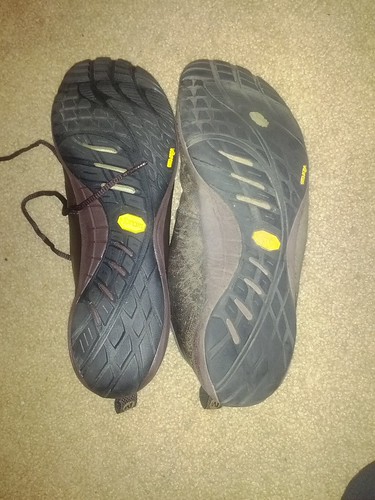
- Shoe wears through faster than they should: Although they wear well, the thinnest part of the entire shoe is the spot that you'll wear through first. Right under the ball of your foot. This is directly related to the above point, but I consider a different failing of the shoe because it could be caused by a different flaw.
FYI, if you don't care about the leather property, check out http://www.lemingfootwear.com/ , as his shoes are somewhat cheaper, and look to be more minimal, more barefoot, and more neutral. I haven't tried them yet, as they aren't leather, but I've put in a uh... feature request?.. for them to make leather ones in the future. Cross your fingers, and if you agree maybe send them a note yourself!