

Ski bumming in the Sierra
2012-03-04
On friday Jess and I decided we should go skiing this weekend.
So, we drove up on friday, found an untraveled road up near where we were headed and slept in the truck that night. Next day we grabbed breakfast and rented ski's from the village at bear valley. They were super friendly. Then, we headed up to bear valley ski area. In general everyone at and around Bear Valley were friendly and happy and would joke back and forth with us. It was a great atmosphere.
I'd never ski'd before, I'd been on a real mountain on a snowboard once, and cross-country ski'd once. Jess was a great teacher (I.E. she explained the basics, ski'd behind me, etc. :P). After 4 green runs I decided it was time for blues, we did several blue runs, then ended up somewhere we couldn't see another way down, so came down a black.
I actually never fell until the black. On the black, despite it being short, I fell a lot, but I made it down! :D.
It was super warm, so we were wearing ran pants, short-sleeved shirts (Jess was in a tanktop), and sunglasses. I only wore gloves part of the time. The lifts weren't even cold.
We stopped for lunch and heated up some clam chowder at the (surprisingly nearby) car, then went back for a bit more. As it turned out we could've even brought in a picnic lunch. After a couple of runs though I realized my knees were out of juice - it turns out skiing when you don't know how to ski uses a LOT of knee muscle. By then I had decent control, but my muscles were starting to max out, and I was losing control of my skis. So, we called it a day before either of us got damaged.
We still had some day left, so we drove back to the village and returned the skis. Then, after a few U-turns, we stopped by the sherrif's office to get fire permits, then to the cross-country place to get a sno-pass. Then, it was off to the end of 4 where the road is closed. We parked here and after some repacking walked off down a snowmobile trail for the night with our packs and snowshoes.
We ended up camping in what is actually an established campground! It was closed though, and it's on national forest land, so we figured no problem. Our spot was on the edge of a beautiful lake with a view off to the mountains. We spent some time stomping down a spot to sleep, and then hunted up a bit of firewood.
One tree obliged me greatly when I found a very dead limb and tugged at it slightly, the tree let go. I thanked the tree and carried it back to camp. We bemoaned the irony greatly and kept considering, but decided we really shouldn't cut enough pine boughs to support a fire on top of the snow. So, we gave in and cooked dinner (ramen) on my woodstove. That worked fine. A bit of rum and chatting until after dark, then sleep.
It got *much* colder than we expected that night, we both woke up quite chilly, and didn't sleep terribly well. Our water-bottles froze enough that we couldn't get water out of some. Oh well, so it goes. Because of the warmth the previous day there was tons of hoar frost everywhere! Our sleepingbags were a bit damp. If I was on my side the shoulder that was up would get cold, despite having shifted all of the down to the top side of the bag. Overall we were certainly fine though, and it was so pretty we both agreed it was absolutely worth it. So much better than a hotel.
Next day we wandered our way home stopping at a couple of parks, including mount diablo. After some searching we found a way in on the backside. Walking around we marveled at the biome there. Beautiful pine nuts and oak trees. Tons of nice open space with grass and some water. We saw a lot of dug up ground where pigs had clearly been rooting about. The greenery was fresh and tasty looking. We sampled the stalk of what we believe was a wild artichoke (it was definitly a huge flowered teasel). It had an interesting flavor, pretty good though a bit strong.
So... total recurring costs to go skiing: Ski passes, gas to get there, food. In addition we had to purchase a snow park pass for this winter. Overall, pretty awesome, and WAY more fun than any hotel. This was a great use of boondocking.
quick and dirty knife sheath
2012-02-20
While at Wintercount this year I bought myself I new knife from Mike.
It's beautiful, and I want to use it for bushcraft stuff, to do that though it needs a sheath, something it didn't come with.
Well, this is a quickly solved problem. I've made one sheath before, but wasn't super happy with the result.
I'm calling this a "quick and dirty" knife sheath because the "right" way to do it would be to use full-grain leather and harden it, getting it wet repeatedly. Instead I wanted something I could make in a couple of hours from stuff I had on hand. So here's the result:
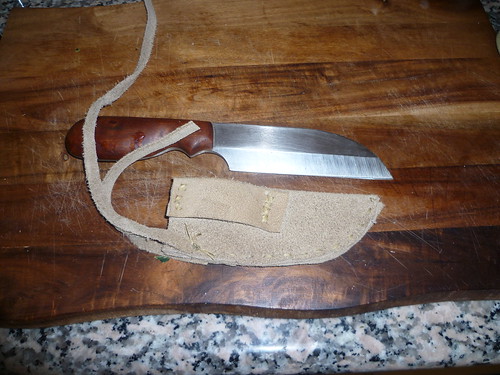
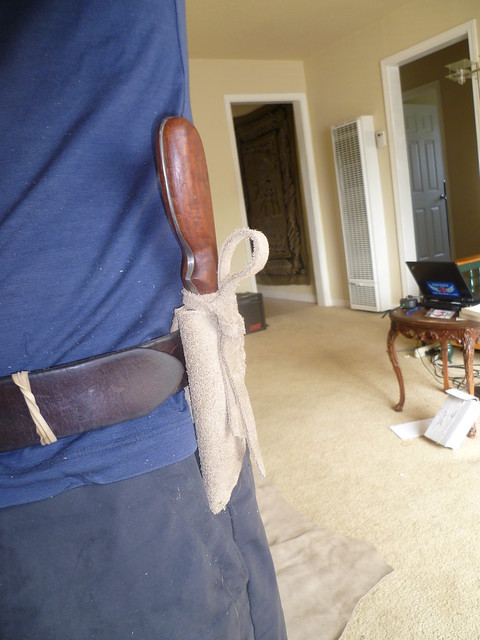
This was made from a chunk of leather I got a while back from a frabric shop on super sale. As you can see it's not super-nice stuff, but it was cheap, and it's pretty tough. It's a simple welted knife sheath with a belt loop and a leather thong to tie the knife in place.
The welt is an extra layer of leather that goes between the first two layers to help protect the stitching, it runs just around the stitched edge, and is stitched directly through, so the stitching is running through 3 layers of leather. Note that my knife has the blade on the flat side, this simplified the process slightly, as I didn't have to be picky about ensuring the welt would stop the blade from cutting the stitching.
Process:
I started by taking a piece of leather and folding it over my knife, then cutting about 3/8" from the blade. This gave me the basic chunk of leather for the sheath.
Next, to make the welt I took one side of the remnants and cut a second curve along my original cut, about 3/8" wide. This made a nearly identical curved piece, which I cut to size to fit properly on the edge of the folded piece of leather
I then cut out a piece of leather for the belt loop. If I stitched it the sheath together first, adding the belt loop would be extremely difficult. doing it first, on the other hand, makes it pretty simple.
For all of the stitching I used a metal sewing awl to punch the holes and stitched it with a large needle and waxed linen twine. I missed the hole one time actually, tried to use a sewing palm to force it, and snapped the needle (which, unfortunately, was borrowed from Jess... oops!)
Next I did a straight running stitch down the side of the sheath, going through the welt in the middle. This step is where you really need a very strong awl and strong hands, since you're punching through 3 layers of leather at once.
Once that was done I stitched on thin strips of leather to tie the knife in place. I'd considered a single strap going over with a snap instead (which would've been added before sewing up the sheath), but I decided I liked the idea of something I could make myself, rather than using a commercial snap. For these strings I simply punched two holes in each, and, using the holes already used to stitch up the side of the sheath I attached both strips of leather on at once with a doubled loop of twine and a surgeons knot. I made them a bit longer than needed and cut them after figuring out how I'd want to tie it.
We'll see how it holds up, but I'm pretty happy with the result. Now I get to try this gorgeous knife out in the field!
more photos
http://www.flickr.com/photos/smalladventures/sets/72157629405206083/
Trip to Henry Coe (A.K.A testing tarps in a hurricane)
2012-01-21
Our backpacking trip turned into one night car-camping, sleeping in what was probably the biggest storm of the year here, while testing brand new tarps, in annoying soil that wouldn't hold stakes.
There was wind, there was rain, there was soil we were trying to stake into washing down the hill. Apparently it was 1.21" rain in the last 24 hours (not THAT much). It was barely raining when we arrived, and stopped before we left, so most of that 1.21" was probably in 12 hours ~8pm to 8am. The bigger issue was wind. It's hard to find past weather, but I'd say that it was gusting well over 40mph. It turned out one of Jess and my tarp poles was aluminum. Well, it's now permanently curved. The pole that bent was from my tarp-tent. I've used it through several major storms before, and I've read of the same poles being used in storms at the foot of Everest and bending nearly 90 degrees without problems. This time the tarp poles were bending badly enough that we switched to hiking poles to keep the shelter up enough that we could be under it.
Well, this resulted in some histerical laughter and was definitely fun - just in a very cold and wet sort of way. Jess and I made it through the night resetting up the tarp regularly, coming out fine but damp. Chris and Zoe more intelligently availed themselves of the back of our pickup, abandoning their brand-new tarp rig for the evening. In the morning, after packing up the wet gear we decided what we really wanted was nice hot food and cocoa.
The trip was not exactly a success, but it was not exactly a failure either. We learned that bendable poles don't work in serious storms. We learned my pole was aluminum. We learned that groundhogs are still the best stakes (Chris' Ti stakes pulled out even more easily). We learned that even the best stakes won't hold in soil when the soil turns to mush - although a full toolbox put on top of the stake sure does help :P.
This was Jess and my first trip with Jess' new Cuben tarp. It doesn't stretch at all, which was interesting. I think it means it shocks the stakes harder, but it also means it doesn't sag through the night. Jess found it meant you had to pitch slightly differently because it doesn't have spring to it and your not aiming to overtension the same way. Her tarp is 10' by 8.5', so very roomy, that wasn't an issue. We had tons of space to be away from the edges. It also stayed almost entirely dry on the underside, I'm not positive that the dryness isn't caused by this tarps lack of tiny holes yet, but I think it's actually that it doesn't have good nucleation points. basically, water doesn't condense on it easilly.
Our biggest mistake was probably flying the tarp. Jess has tie-outs on 6 points (each corner and one on each side) with knots set up so we could tension them. Using these leaves the tarp flying about 6" off the ground. This is *great* in downfalling rain where it gives you a bit more headroom and helps with airflow. It's terrible in side-blown rain. Oops. Additionally we set the peak a bit too high, which probably caused it to catch too much wind. We should've been aiming for the lowest pitch we could stand. One last thought is that possibly a lower angle on the end stakes would've helped reduce tension.
In any case, much was learned. We made it through the night. Now all our gear (including our damp sleepingbags) is drying. Jess is curled on the couch taking a nap.
4-wheeling at Carnegie SVRA
2012-01-09
Jess and I like to get pretty far into the back-country, yet we often don't have time to walk there (I mean, it's a long walk from the bay area to the Sierras). As a result we sometimes find ourselves in a vehicle on dicey trails. With the ability to carry gear, sleep in it, and be migratory in the modern era, a vehicle is surprisingly tempting as part of an outdoors lifestyle. Anyway, that's my excuse, it's also possible that 4-wheeling is just fun.
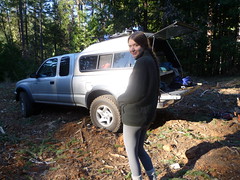
A while ago I created a mailing list at work for 4-wheeling. The other day someone posted that they'd just gotten a new jeep and wanted to play with it. My friends who wheel aren't in the area, so I haven't been able to try anything where I might get stuck. I'd been to Hollister off-road park before (with a friend who's rig was too small to pull me out), and have tidbits of experience here and there, but nothing very intense. Carnegie SVRA is nearby, and neither of us had been there, so it sounded like a good option.
Some quick terminology
-
A "rig" is a vehicle, whatever it is you've got.
-
4-wheeling refers to driving a "rig" in an area that would be very difficult or impossible to traverse in a vehicle that isn't built for the task, down ruddy dirt roads, up rocky trails, through mudholes and up and down steep hills.
-
A Transfer case, or T-case, is the component in a vehicle which transfers energy from the transmission to all sets of wheels. Often these are switchable 2-wheel to 4-wheel drive. Some, like the one on our truck, also act as a second transmission, letting you go to gears far below "first". Most such vehicles have only 2 gears in the T-case, "high" and "low". High is for normal driving, low is for the tricky stuff.
-
Ground clearance (often just clearance) is the distance between the ground and your vehicle when sitting on flat ground. This is a very relevant property if your vehicle is on a road with big rocks for example.
-
Breakover angle: Consider a wedge sitting on the ground point up, imagine driving a wheeled vehicle over that wedge. A vehicle can drive over a very shallow angled wedge, but if the point is sharp it will get stuck or "high-centered" sitting on the point with one set of wheels off the ground. The sharpest angle at which a vehicle can still drive over the wedge is called the breakover angle.
-
Entrance angle: Imagine a car coming down an incline towards a flat surface. At some angle of incline the vehicle will just sit on it's bumper when it reaches the flat surface, instead of sitting on it's wheels. The maximum angle where it's wheels hit instead is called the entrance angle
-
Exit angle is the same concept as entrance angle, but the vehicle is transitioning from a flat surface to the incline (driving forwards still)
So, that's some quick 4-wheeling jargon. Now for the story.
Story
Manish brought his wife (apologies, I'm not going to try to spell her name, but she is the excellent photographer who took all the photos in this post) and their dog, as well as a couple of handheld GMRS radios (I haven't gotten any of my radios speaking GMRS yet). Jess was feeling tired so didn't come along. We met near our abodes and caravaned up to Carnegie for the day.
Well, it turns out Carnegie SVRA (unlike Hollister) has no trails at all for 4x4. On the other hand, they do have a pretty amusing "play area" for 4x4s. Being relatively new anyway this satisfied our appetites for a while, though I probably wouldn't go back.
Here's our vehicles:
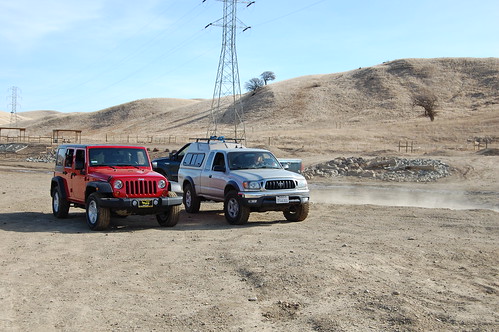
Manish's Jeep (red) is 100% stock, automatic transmission 2012 4d jeep wrangler sport, about 2 weeks old. My pickup (silver) is a nearly stock 2002, manual trans, 2.7L, extended cab, tacoma TRD (no locker), but I swapped the tires to 265/75 BFGs instead of 265/70. Jess and I call our truck "Jane". Overall I had a bit more clearance and better offroad tires than Manish, but he had a bit better skids and entrance/exit angles, making the rigs about equally capable. If you didn't follow all the adjectives don't worry, I threw it them in case someone cares.
After a quick run through the sand-pit, playing a bit on the bumps, and realizing our breakover angles were not sufficient for the harder "bumps", we decided to try going *down* the "steps". Up was a bit above our levels still. I went first:
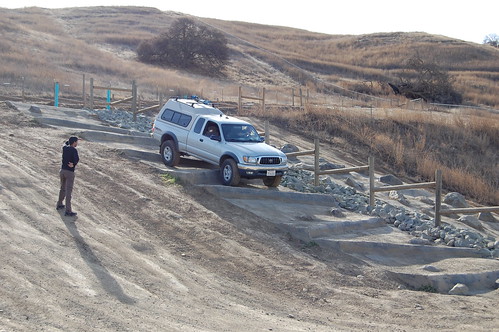
I scraped the tail-pipe once, and at the bottom I bottomed out due to entrance angle.

Luckily, the tacoma comes stock with a lightweight skid up front, so no damage was done (people will say it's just for looks, but it's better than that - just don't try and sit the whole car on it and slide over a rock). The plate hit pretty hard, but after suspension rebound my front wheels were on the ground, so I could drive out without a problem. The suspension on Jane is pretty shot, so if I let her drop a bit too hard off an edge she'll bounce pretty badly. This meant I bottomed out the suspension several times when I came off the brake a bit too much - I kept thinking I'd kissed a rock when I hadn't.
During this descent I tried a couple of techniques (Manish used descent control on his jeep - cheater :P). I tried putting it in gear and leaving the clutch in, but that never worked out well. I wanted to go too slowly for my crawl ratio (slower than the lowest gear on the truck with the engine spinning ~200 rpm, below that it dies). I also kept wanting to stop, which required working the clutch anyway. Thus I kept killing the engine. Instead I found using just the brakes worked better when I wanted to move THIS slowly. I found it surprisingly easy to do it with just the brakes - though lower crawl ratio is clearly the way to go if you have the time and capital.
Here's Manish doing the same.
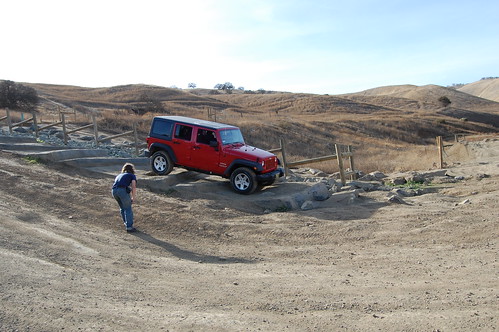
He dragged his skids pretty badly once or twice, but made it down safe.
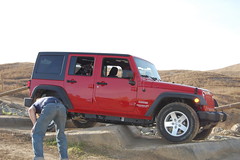
Any time manish got 2 tires coming off a drop at the same time his rig would slide. This is the downside to more street'ish tires. He had traditional stock streety A/T SUV/truck tire (think AT dueler). The larger lugs, softer rubber, and larger diameter on my BFGs let me avoid sliding a lot more often.
We took a look at the main mud-pit, but after talking to someone who'd tried it and gotten stuck we decided it was way too much for our rigs. Next we decided to try the "frame-twister" which was a set or rock and log obstacles. This is relatively tame in the greater scheme of things. A more heavily modded rig could go relatively fast, for a good stock rig it's a slow but doable crawl.
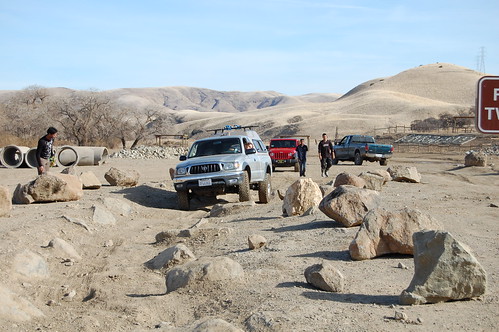

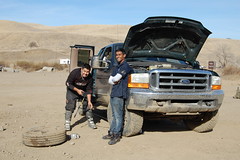
We watched a stock land-rover do it as well, and a kid in a larger truck do it several times quite quickly. Unsurprisingly he ended up blowing a tire - presumably just from the pressure of running direct up against a rock at speed. He was running A/T Revo 2's, and his rig was enourmous. Extended bed, extended cab, pickup with a V10. We helped them change their tire
My main take-aways from this trip:
1) These vehicles, even stock, are both massively capable. I was vaguely aware of this, but I still keep being surprised.
2) Going slowly and smoothly in a stock auto is a lot easier than going slowly and smoothly in a stock manual. Even with the low range on the transfer case, it's just not as low as you want. Don't get me wrong, I'm not giving up manual any day soon. I love using it for steep descents and for general driving, but for anything crazier than what we were doing I'd want a second T-case to raise the crawl ratio. Surprisingly, I DIDN'T burn the clutch at all! Despite floating the clutch a bit to crawl slowly over a number of the rocks (Idle was insufficient torque, that's what I get for driving a 2.7L I4).
3) While Jane's clearance is sufficient for a lot of somewhat crazy stuff, another inch or two would be amazing. Good thing I have a lift kit in the garage just waiting to be installed :). This is an all suspension kit (bought largely in parts), so it should increase suspension travel and flex as well. Most importantly it'll replace our blown springs and dampers.
More photos here http://www.flickr.com/photos/smalladventures/sets/72157628817096551/ (courtesy of Manish Jain's wife)
Mussel Foray
2012-01-08
One of the meetup groups I follow had a mussel collecting foray this weekend, so we departed from our usual loner ways and tagged along. The five of us met up in Half Moon bay with our buckets and boots and hiked out across the beach and the eel grass to towards the mussel rocks. It was an extra low tide (-.6) due to the full moon, so travel was easy. Almost immediately someone found sea snails. They don't hold on tightly, so it's easy to just scoop a handfull at a time out of the shallow water pockets left behind as the tide went out.

After hopping across several little water ways we got to the mussel rocks. They looked pretty much like mussel rocks always look - encrusted up and down with mussels of various sizes. Only this time we were going to eat them. :) We took a quick detour first though and collected a few sea urchins. They were a bit of a challenge, but if you can get a good hold on the far side of them then quickly tilt them towards you they pop of the rocks pretty easily. There weren't too many though, so we only took a few.
Then it was time for the main attraction! Mussel harvesting went even faster than the sea urchin harvesting. I just put on some gloves, grabbed a big one and levered and twisted it off. Ones in the center of a tight community are almost impossible to budge, but if you can find some large ones near the edge they're pretty easy to lever off. Everyone else was harvesting without gloves, which worked though resulted in a few cuts.
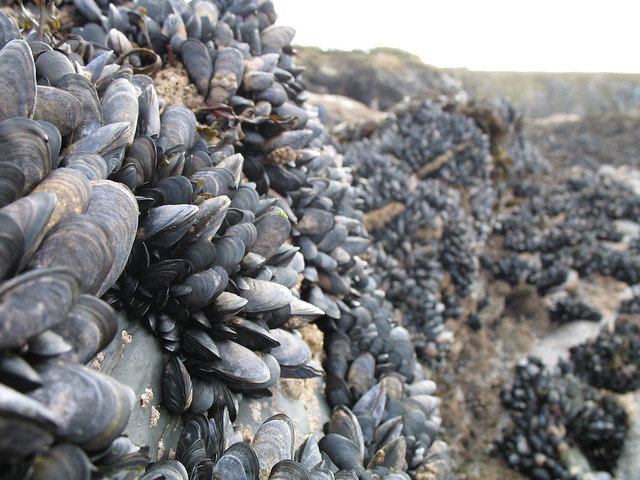
Brewer and I quickly gathered as many as we thought we'd need for dinner and helped some of the other people get up to their limit. It was too much fun to want to stop harvesting. On the way back we wandered around peeking in at the sea anemones (for giggles try trowing on some food) and various sea weeds. Unfortunately none of us knew anything about the seaweeds, so we let those be.
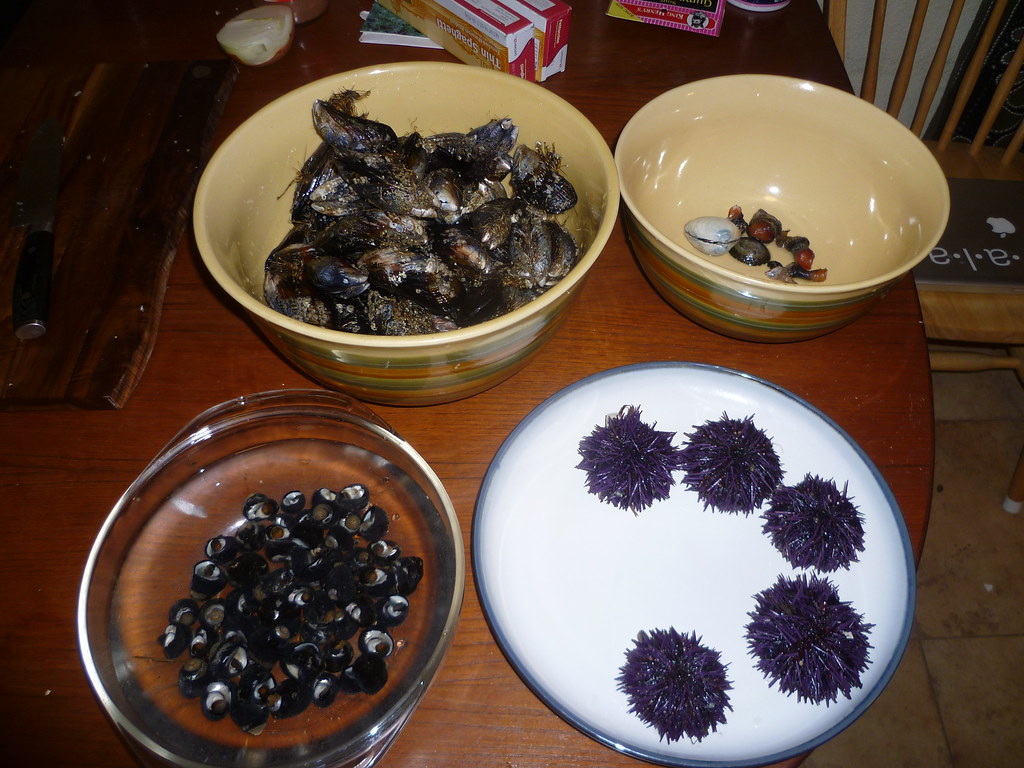
The catch!

Back at home we rallied the troops and started in on making dinner. The sea urchins we prepared by tapping them solidly on the mouth side until you can lift out the mouth. Then I used my finger to detach all the black bits from the inside of the urchin and poured them out, leaving only the orange gonads. We ate this uni both straight and after rinsing them off in fresh water.
Unwashed they start quite salty and then transition to sweet. It's an interesting flavor, but a bit too intense to eat straight, which is what we were doing. I'll definitely try and cut them with some other food next time, maybe spread them on bread.
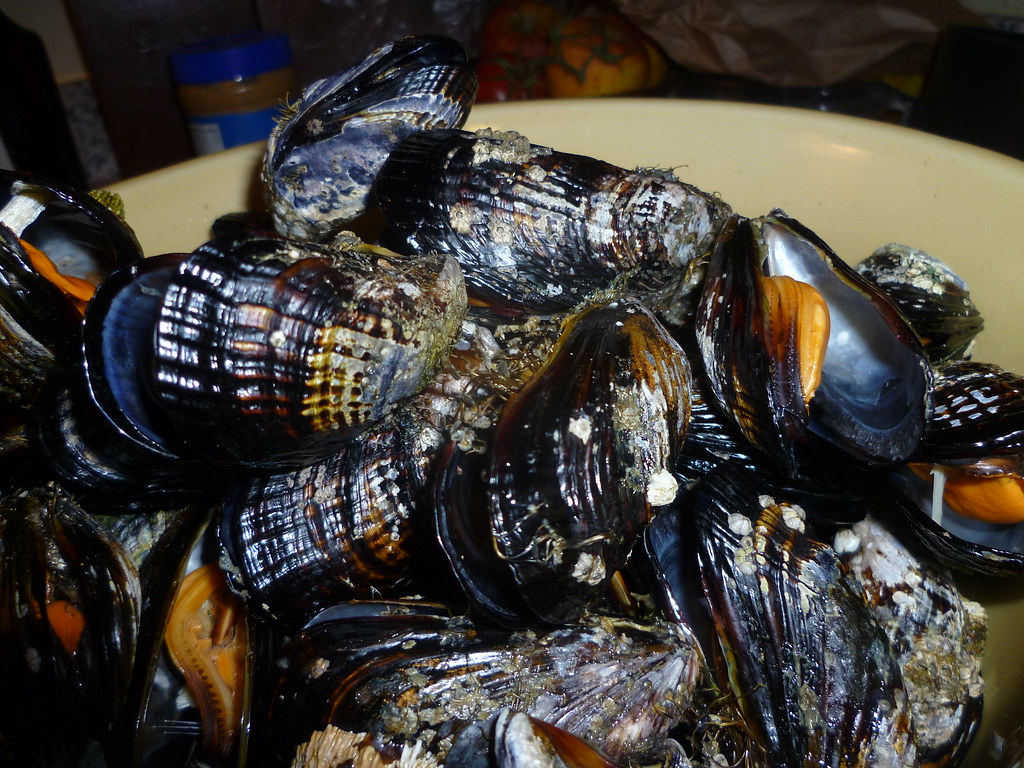
We rinsed and scrubbed the mussels (leaving the beards on) and then steamed them in some white wine, garlic and onion. After all the mussels were steamed we poured off most of the liquid from the steaming pot, being careful to leave the grit behind, and poured it over a pot of spagetti with some more butter. We did the same thing for the few odd ball sea life that we'd also picked up (some of it accidentally). The spagetti and mussels were amazing. The beards pull off the cooked mussels easily, and there was almost no grit. Everything tasted sooo good. We couldn't even come close to finishing all the mussels and had to give them away to several neighbors. Eight mussels a person turns out to be about as much as anyone can eat with a bit of pasta.
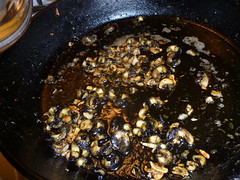
I used
this recipe
for making the sea snails. Getting them out of their shells wasn't too bad - we mostly used small screw drivers and finishing nails to poke them out due to a lack of toothpicks, but that just added to the amusement. The snails had two main sections internally. A mostly black foot, and a white/brown tail part. The two pieces detach easily. We decided to try and use both. The snails came out tasty, a bit tough, and more gritty than I would have liked. We at them up, but next time I think I'll wash the snails again after getting them out of their shells, and I might cook the tails separately from the feet 'cause I think they may have been causing some of the grit. We ate this over the spagetti as well.
In the end we were stuffed and happy with wine. I call it a success.
More pictures
here
A note on legality
In California all you need to legally collect mussels is a fishing license and a scale (you need a way to ensure you aren't exceeding the bag limit). According to this site the bag limit is ten pounds. Determining where you can collect is tricky, and at this point I'm considering calling to determine if some other spots I'd like to try are legal. Also it's not safe to collect filter feeders around San Francisco in the summer months as they can harbor toxins. To prevent accidental poisonings California has a mussel quarantine from May 1st to October 31st, so get out before then.