

Trip report, sierra forests
2011-12-24
We wanted to get out and into the woods, practice firestarting, anmd do a bit of hiking.
Jess picked a spot by looking at Google maps satellite imagery. She made sure that it was in a national forest, so we could do fires and stuff without worrying about park rules. On the map it was on a dirt forest road, but with nothing nearby and we could see that there were other dirt roads spidering the area.
I decided it was more fun not to look at the weather :). I didn't check altitude or anything else. So instead we packed *everything*. We had snowshoes, ice-axes, the whole shebang. I also brought a machete, and we brought buckeye and saguaro sticks for fire drill.
We headed up friday evening, and with a couple of delays still got there ~11:00pm. The dirt road was rough'ish, making for a bit of fun in the truck :D. I used the low gear just for safety on descents, especially with the low-light and tiredness. We parked up off the road and went to sleep in the back.
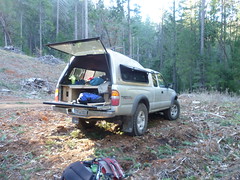
The next day we drove a bit farther down the road, parked, and after a quick sighting, walked off down towards the joint of the valley we were in and another one. Having no maps I was a bit nervous about getting back to the car. We considered it on our way down and figured we could follow the river back up the valley, then cut right and intentionally hit the road a bit back from where we'd parked. That was the plan anyway.
The woods were interesting. It was mostly conifers, surprisingly brushy for an area that gets logged. The hills were relatively steep, but passable. Compared to mendocino it was almost easy, compared to nearly anything else... not so much. The forest didn't seem terribly healthy sadly. The trees were mostly young, large amounts of deadwood lay in heaps (not randomly like an untouched old-growth forest). The undergrowth trended towards sticky brushy stuff with little space for pot herbs and such.
When we hit the stream Jess had the presence of mind to look around and find some markers. She pointed out a redwood and an oak tree overhanging the river.
A bit down the stream I noticed there were marks on the rocks that looked like boots had slid on them. I found that pretty interesting. When I told Jess she pointed out bear markings on a tree next to me that she had just noticed. I had thought it was a boot because what I saw was moss scraped off by a what appeared to be a hard surface.
Not far down the stream we found more bear markings on trees, but also more boot prints. Sure enough, we were both right!
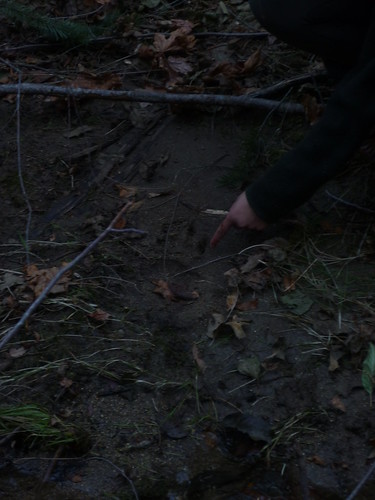
Right around there we also found this print in the mud, just in case we weren't sure about the bear yet:
We found a downed tree that we thought was redwood. Jess noticed that the inner cambium looked pretty interesting, so we stopped to poke at it. Jess quickly made a few feet of cordage and I slowly made about a bit over a foot :P. It was about the same resultant quality as unprocessed yucca, but a bit easier (and with no pounding). VERY encouraging. We didn't try it, but it felt like you could use it for spinning up fire. For trapping you could probably use the strips even before twining.
Eventually we got cold so after a snack we continued down to the valley. Our hope was that where the valleys joined we might have a bit of a wider valley and maybe some meadow where the rivers might delta a bit into each other. We were kindof looking for an area with wide diversity, the area we'd parked in was cool, but if we could find meadows or other types of areas as well, bushcraft would be a lot easier here.
As it turned out there was some almost meadow, but not flat and still under trees. As we got into the more open forest we started seeing more deer trails and the travel got MUCH easier. In the valley we found quite a beautiful river.

After sliding on the ice for a while and generally enjoying the river we headed back. With it being winter it was already getting somewhat late. The trip back was complicated somewhat as we hit the wrong swale a couple of times on the way back. It didn't look right and the compass bearing gave us a nice double-check. We used a combination of jumping swales and heading downhill to get back to the main stream we'd followed. This worked beautifully and we quickly found our way back.
When we got there it was already getting dark. I took a quick try at spinning up a fire with a hand-drill using buckeye on saguaro, and Jess lit up an a fire with a sparker so we could actually cook up dinner. We had tasty lentil soup with cheese. Jess thought to gather up boughs of whatever tree it was (fir I think?). Someone had cut a bunch and left them lying around, likely loggers or similar? Anyway, we gathered them up as a seat for use while we cooked and ate dinner. When bedtime came Jess decided she wanted to try sleeping on them.
There was a lot of deadwood left from logging. So we burned a fair bit of wood with no guilt (we actually cleaned up the area some). We kept the fire going most of the night, but at some point I went to sleep and it petered out. I was a bit cold after it went out due to my sleepingbag being worn out. Jess also got a bit cold due to a hole in the boughs where her hip sat. We slept fine though overall.
The next morning we decided we really wanted to spin up some fire, so after breakfast (cooked on a fire restarted from the coals of the previous night) we gave it a try. We both got pretty close, but neither of us succeeded. My closest was buckeye on buckeye, though buckeye on saguaro was clearly a good combo (if hard to find in the wild :P). We only had the gear for hand-drills so that's what we were using. I got good dust buildup relatively tightly packed and good heat, and I got plumes of smoke, but it didn't ignite.
Amazingly our hands didn't blister. Nathan, someone I met at earthdance several years ago, taught me a trick that I think was responsible. You clap your hands until they're red before you start, which helps give the same protection that blisters would.
Eventually ours hands were sore and tired (if not blistered). So we cooked up some split pea soup with salami for lunch on the existing fire, put the fire out, and went on a hike up the road. It quickly turned into a pretty tricksy road (had we been in the truck) and then into a trail. Up there it was a lot more open with fields and such. We heard some hunters not far away who fired at something (presumably deer).
The night before we'd actually heard dogs that appeared to be for hunting - they'd bark a lot in one location for a while so I suspect they were treeing something. Not sure.
Anyway - we drove home contented, full, and generally in much better moods than when we left on friday :). Our conclusion about the area is interesting, not bad, not terribly healthy, and we need to find a south facing slope.
More photos
http://www.flickr.com/photos/smalladventures/sets/72157628707645353/
Link farm
2011-12-22
Been doing some primitive skills reading lately so I thought I'd share.
http://paleotool.wordpress.com/
- A well written blog by the guy who taught me how to make ghillie shoes. Lots about gypsy caravans, shoes and just general neat stuff.
Two interesting sites I found from his blog:
http://www.cd3wd.com/cd3wd_40/cd3wd/index.htm
- A collection of articles on how to do almost anything. Seriously, webpage design to nut oil extraction to livestock management. You name it, it's probably there.
http://trackerofplants.com/
- A blog by a lady in Oregon who does a lot of gathering
http://www.primitiveways.com/fire_materials.html
- Woods to use for friction fires in the bay area. I managed to get smoke with a hand drill from buckeye on buckeye last weekend. It's an impressive wood. I got a little closer with buckeye on saguaro, but that'd be hard to find without a long drive.
More huaraches!
2011-12-08
Back in
this post
we gave an overview of several types of minimal shoes. Since then I've been wearing huaraches almost exclusively.

The longest day of backpacking I've done in them was
17 miles
(established trails, very light pack). The balls of my feet were a little raw by the end, but that was mostly from the friction between my foot and the top of the rubber sole. You could probably decrease that by gluing a piece of garment leather to the top of the sole, but I haven't bothered. I like having tough feet. :)
Recently I went for a six mile hike on sand and small pebbles in Joshua Tree and didn't have any issues with rocks after the first half mile or so. Somehow it seems like you learn to walk a bit differently after a while so you don't pick up as much junk. Initially I strongly recommend carrying a different type of shoe to switch to if you're planning to do a long wilderness walk. Well, that or just wear five fingers, or Merrell's trail glove. That way you can get used to a thin sole before battling the pebbles. I wore my five fingers backpacking until I wore through the sole.
Mostly I wear my huaraches for normal day to day wear. Short runs, hanging around in the office, biking... just normal life. One surprising side effect of always wearing them is that lots of interesting strangers have started conversations with me on public transit. Also a shocking number of people think they're really "cute." Go figure.
Pros:
- Cheap. ~$20 a pair if you buy a kit. Less if you're creative.
- Easy to make and repair. It took me about twenty minutes to make my first pair, and I've repaired them several times with a pen or pocketknife.
- Pack small
- They also seem surprisingly good for running, though I'll admit I haven't run much distance in anything else as I'm just getting into running now.
- Closest to barefoot you can get and still be fed at restaurants.
Cons:
- Pebbles! They sneak in and poke and you have to clear them out fairly often until you get the hang of walking without scooping them all up.
- No socks. Because of the string between the toes in the standard lacing setup you really can't wear standard socks with them. On cold mornings I wear my
ghillies
instead to keep my feet warm.
- Not great for side hilling and parkour. When applying force 90 degrees off from the direction you walk in the sandals try to rotate around your foot and it can hurt a little bit.
Tying method
People have been going crazy coming up with new lacing methods for these things, but I've mostly only used two: slip on and traditional. I prefer the slip on method for walking. Because all the strings in this tying method are doubled none of them end up digging in quite as much, especially on the back of the foot. Unfortunately I find it difficult to keep this method a just the perfect tension for running, so my shoes end up a bit loose. It makes it more awkward to run and the slack allows everything to slide more creating more chafing.
So lately I've been using the traditional style. Ironically when I went looking for directions I seem to have accidentally made this style up. I start with the basic setup where the string goes from between the toes, to the outside, then around the heel and to the inside. If you watched the video he talks about wrapping the string back around right after you go through a hole to "lock it" in place. I've found that I enjoy doing that several times at the inside hole. This raises the string on the back of the heel, so it's less likely to fall off. It also allows so play in tension between the back of the heel and the part you re-tension and tie every day making it a lot less fiddley.
After doing the wraps around the hole I wrap the remaining string around my ankle and lower leg until there's just enough to tie off. Then I tie off to the string coming from between the toes to the outside with an overhand knot and slipped overhand knot (make the knot like usual, but don't pull all the tail through, so you end up with a little loop). One overhand doesn't seem to be enough to hold it, but the second one being slipped makes them easier to get off again. It also lets you eat up a bit of slack in the loop so you don't have a long tail dangling around.
This tying style is what I've been wearing almost exclusively lately, though mostly it's because I'm too lazy to switch between them every time I switch between walking and running. Feel free to experiment though. Fundamentally you're just tying a piece of sole to your foot. There's lots of room for experimentation.
Sole Material
There are several different choices for sole material. My first pair was a leather sole (fairly thick cow hide). Those lasted me about three months and were super comfy. They are floppy though, so it takes a bit more skill to keep small stones out of your shoes. I suspect they'd last a lot longer if I wasn't mostly walking on pavement though.
Hoping for a longer wearing sole I bought a sheet of Vibram Cherry Outsole from invisible shoes and used it to make a pile of shoes (huaraches for Brewer and I, new soles for Brewer's Ghillies, and fancy sandals for a friend). Those soles wore quite well, though were a little floppy. The holes on the sides eventually ripped out, but that's pretty trivial to fix even in the backcountry. I wore these soles for about a year.
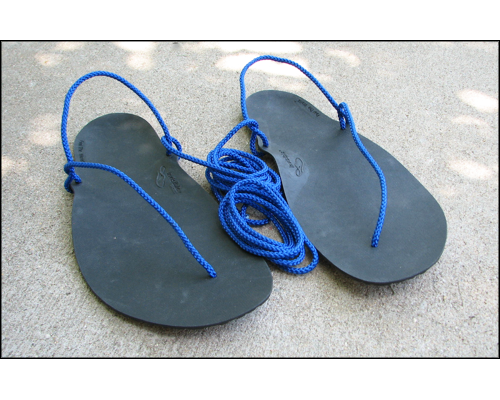
I eventually retired those and have a new pair with the 4mm Connect soles. They're pretty similar, though the side holes are pre-formed so they shouldn't rip out as easily. They're also shaped slightly so it's a touch easier to keep rocks out. I am using their laces this time instead of random string from the hardware store, and while it's comfier it also wears out way faster, which I find annoying. When I get around to it I'll switch back to a leather lace. Leather laces are a little harder to get your hands on, but have a really nice amount of give for walking and the knot on the bottom wears pretty well.
I've also seen people using mountain bike tires, but I haven't tried that. If I was spending less time on pavement I'd probably just use leather soles, but the various rubber soles are a nice compromise for city living. Ideally however I'd like to use the cherry material and make myself some moccasins for the winter so I can wear socks and keep the rocks out. It'd probably also make it easier to keep dry feet. So far my ghillies are doing okay for wimpy California winters though.
Update: The connect soles have lasted wonderfully. I've been wearing them as my primary shoe for at least fix months now, and unlike the cherry sole the side holes haven't made any signs of ripping out. The string also stopped wearing out as quickly once the sole warped to my foot. It just took a bit longer than it had for the other soles. I also found an old un-belted car tire so I'll probably try that next.
A cutting board
2011-12-05
After our trip to Joshua Tree, Jess and I decided that we really ought to have a cutting board in the truck. We already have pots and a stove that live in the car, I just purchased a couple of Mora knives to live there as well (they're on their way).
So, we wanted a specific sized cutting board that would fit nicely into some nook or cranny in the truck boxes that's otherwise hard to use anyway. We were running out to a large hardware store (Lowes) this weekend to grab some things the local one didn't have and Jess asserted that such stores always have planks of good hardwood for reasonable prices. So, (me not believing her) we poked around and sure enough, for $12.00 we found a good sized piece of oak plank, maybe 1" thick, just a bit larger than we needed.
That afternoon I took out our roughcut saw (we have that and a just purchased coping saw, so I figured I'd make it work). I gently sawed through the wood trying to avoid snarls and rough edges as best I could. I cut it such that it would drop behind the left wheel-well (on the camping side of the boxes - the other side is car repair and recovery gear) and slide backwards just a bit locking behind a supporting pillar in the box, so it's totally out of the way.
I then took out a sanding block (we had a couple of foam sanding blocks from cleaning up after moving out of our last place). I sanded the plank for a while until it was starting to feel pretty smooth. Then I switched to a finer grit and did it again. Since it's a cutting board I figured it wasn't worth *really* getting it perfect, so left it at that. By this point it felt and seemed just a bit shiny, but still had some very small pits in it where the grain stuck out.
Next I put on some flax seed oil and spread it about with a rag. It soaked up a huge amount on the first pass, presumably because oak is not a very oily wood (I did this on alligator juniper and it only took in a little). On the second pass that evening it wasn't totally dry yet but close, I added a bit and re-spread what hadn't soaked in. It was totally dry this morning, so I added another coat this evening.
And here's the result:
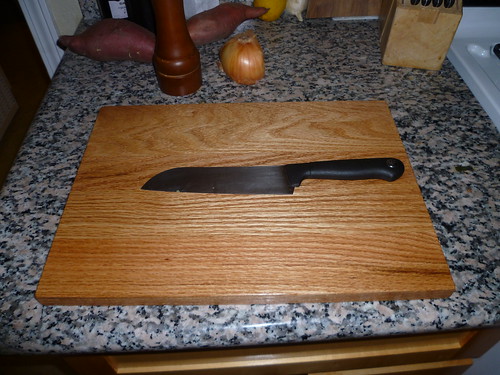
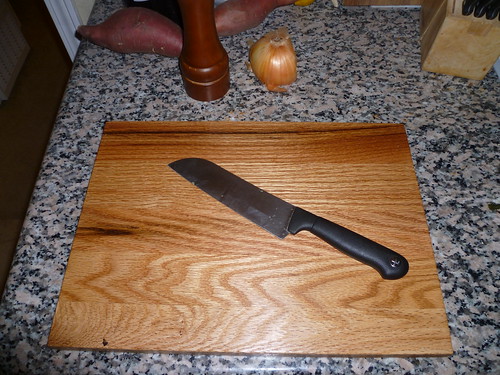
The last coat of oil isn't dry yet, but I'm pretty happy with it. When it's dry it will look exactly as it does now. Based on the last thing I treated this way it should darken a bit over the next couple of months as it develops that patina wood does (presumably some bit of it oxidizes). When I was treating alligator juniper I was making more of a piece of art, also it didn't take in the oil quickly so I did many many coats. With the oak I feel that the couple of coats I did should be fine - if it starts to look dry some time from now I can just add more.
Anyway - this entire project was a total of a $12.00 plank of wood and between probably about an hour total of work. The result is *exactly* what I wanted in terms of dimensions, since I chose. A cutting board of this size made of wood starts at ~$40 based on the one I got for the kitchen, so saving ~$28 for one hour work is pretty good. Owning something you made always has a different feel to it to.
My only warning is... that much sanding is a pain in the shoulder. If you have a belt-sander this is just a trivial project. Doing it by hand is good exercise though! :D.
I'll try and report back on how well it holds up to chopping some actual vegetables!
Edit:
Tried it last night when chopping apples for apple sauce. It seemed to get less scratched than our commercial cutting board gets.
It's not nearly as smooth as I thought it would be, once the oil dried it feels rough again in some areas - but it IS going in the truck. If it was for the house I'd simply sand it a bunch more.
Trip to Joshua Tree
2011-12-01
For thanksgiving this year, a couple of our friends asked if we wanted to join them in Joshua tree - this sounded like an awesome idea, so we jumped on the opportunity.
The idea was to hang out in Joshua tree, climb, and cook lots of food. I don't have much outdoor experience, so it was a chance to build a bit on those skills, and Jess had never climbed outdoor (or at least... not per say with a rope etc.)
Joshua tree, if you didn't know, is pretty much the Mecca for climbers. The rock is amazingly sticky crystalline stuff that's just amazing for smearing, and all the towers of rock make for tons of short and fun routes without dealing with multipitch climbing, many of which even have walk-offs (I.E. you can top-rope them without a lead climber around).
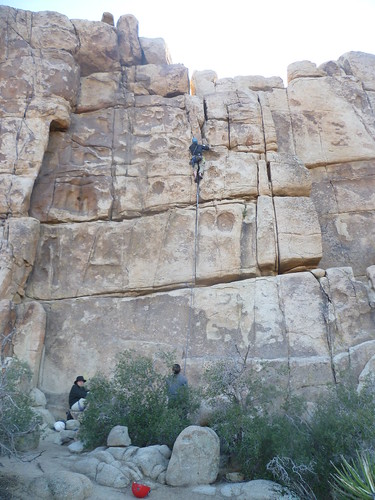
Jess and I drove down to Joshua tree on wednesday. We packed all our climbing gear. Including shoes, harnesses, helmets, beaners, purcell prusiks, 10.2mm dynamic rope, my quickdraws, and 2 30ft lengths of webbing. We also packed all our cast iron. Jess worked with Lizza to plan food, and packed a box with spices etc. Wondering about water, I looked up how much is recommended for burning man, and we brought that much 2.5 gallons per person per day. 4 days, 2 people, we needed 20 gallons. I picked up 4 collapsible 5 gallon containers which we filled with water and put in the back of the truck. Lastly we packed camping/backpacking gear, a few spare bit, travel guitars, and lots of warm clothing since it's winter in the desert.
As it turns out 15 gallons was enough for about 5 people for that time, but at least we didn't run out.
On wednesday we left the house ~9:00, stopped at safeway to buy food, wood and charcoal. We then stopped by the ham radio outlet for a new antenna (I have no idea but somehow it got lost in the garage... silly, but whatever). The truck was pretty loaded and kinda sluggish, but still okay. It's still got the old springs, so it was riding a bit low with all that water food, wood, and gear. We drove all day and got there around ~8:30. Not bad actually.
This was also an opportunity to do a longer road trip in our truck, and test out the sleeping platform and gear storage on a more car-camping type trip. It's a 9 hour drive from Mountain View to Joshua Tree, so Jane got quite the workout. Turns out you have to bring the engine to 4500rpm in 3'rd gear to get it to pass at 55 in any reasonable amount of time :P. But she never overheated even doing that through the desert loaded with all of the stuff described above and the sleeping platform.
We'd forgotten the tarp poles so at first we used the platforms from the truck, but they fell over ever 12 hours or so whatever I did (I was staking into sand) so I gave up and borrowed hiking poles from Brian. They did *work* though, just suboptimal. We decided tarp poles should live in the truck in the future.
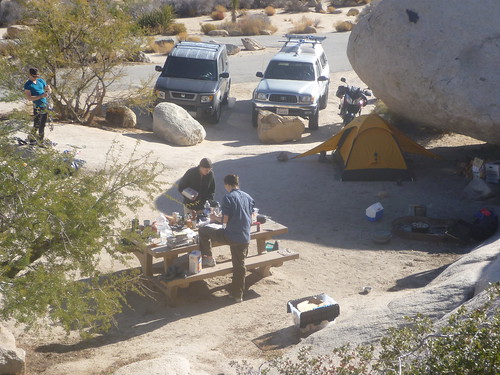
Brian had landed the spot the day before and let another group join us. They were climbers who'd flown out from north carolina. They were massively confused by the piles of food :P. I *think* I have this right:
wednesday night:
Lizza didn't get in till the middle of the night
desert: smores
On thursday we ate
brunch: fritata
dinner: baked chicken, green jello, cranberry relish, fresh baked bread, potato leak soup
friday:
breakfast: cranberry pancakes
dinner: pizza
desert: peach cobbler
saturday:
breakfast: peach cobbler
dinner: corn bread, chili, baked potatoes, some duck brought by friends of the north carolinans, garlic mashed potatoes
desert: bavarian apple tart
sunday:
breakfast: last of the corn bread, vegetarian catastrophe (potatoes, eggs, cheese, and, veggie sausage)
We climbed a number of routes. Mostly in the 5.7 range. I'm really not used to outdoor climbing and Joshua tree is especially interesting with the super-high friction rock (I climb 5.11'ish indoor). I learned a lot about doing "trad" (traditional climbing), that's where there aren't bolts in the rock, instead you put cams and nuts and stuff in cracks and use those to clip your rope into. I didn't actually do any leading since we were doing all trad routes, but I'm now pretty confident in my ability to lead though anyway. Had we stuck around another day I probably would've tried leading a trad route. I plan to teach Jess a little lead belay, then we can do some sport lead routes up at castle rock (sport being with pre-placed bolts), I'm tempted to pick up a few cams and nuts just for setting top-rope anchors in places where I can't sling a rock or tree.
Brian and Lizza brought along their bangel cat Milo (he's an F5, or 5 generations from a wild-cat. He's super fun and playful). He got cold and Brian put a down jacket over him, he quickly learned about this and started burrowing into jackets whenever he was cold... SOOO cute, also jess isn't allergic to him. We'd bring him to the foot of the climbs on a leash.

On friday night though Milo got sick and couldn't keep food down. He threw up a couple of times, and that night peed on Lizza and Brian's sleeping bags. Until bedtime they'd been trying to keep him warm by running the heater in the car and were force-feeding him a water solution with salt etc. on the theory that he was dehydrated.
On saturday they went into town and took Milo to the vet. The vet didn't find anything specific, but it's likely that it's due to a camelback bite-valve he'd eaten a week prior - some sort of blockage. They were going to pick up Milo on their way home. Hopefully he's okay.
Jess and I hit traffic on the way home on sunday and didn't make it. I was getting too tired to drive as we passed henry-coe so I pulled in there and found a spot on a road where we wouldn't bug anyone. Jess was already asleep on and off, we tried sleeping in the seats for a bit to recover but it wasn't enough for either of us. So, we pulled out our sleeping bags and crashed in the back. It was super foggy for some reason (over almost the entire route back actually). So we just opened the side sliding window's to the screens so we wouldn't end up soaked in the truck. We got up ~5:00am, drove the last bit and crashed at home for a few hours before work. I was in work a little late, but not too bad. We got home safe, thanks to the sleeping platform.
All in all it was an awesome trip. We used our truck for driving everyone around to the climbs because we could just throw the climbing gear in on top of everything else with space to spare, then pile into the cab. So the truck was super win. It was great to hang out with cool folks, and now were really inspired to try dutch oven cooking.
Lizza has this aluminum dutch oven, it cooks almost identically to a cast-iron one, but heats up in a tiny fraction of the time, and you can easily lift it when it's full of food... awesome!
More photos:
http://www.flickr.com/photos/smalladventures/sets/72157628254322253/