

Changing Oil in a vehicle
2011-12-01
I Changed the oil and oil filter on Jane (our truck) last night for the first time.
I made only a moderate mess, yay!
Lessons learned
1) Get a turkey pan or equivalent, tinfoil carefully shaped, even several layers thick, does not count (it tore)
2) Motor oil smell is really hard to get off your hands... a little "exfoliating", 2 types of soap, and about 8 hours seemed to do it though.
3) A full roll of paper towels is a must your first time, extra pans and towels recommended. Think thin runny chocolate sauce, but more prone to getting on everything.
4) At least on my car, it's effectively impossible to keep from dripping some oil. You will drip when you take off the filter, and those drips land on a pan that's part of the car. That pan doesn't have a single drain-point, so it will come out somewhere likely multiple some-wheres. Do the change where a few drips aren't a big deal, catch what you can in pans, but be ready to wipe up a bit too.
Also, I measured the oil level while filling and it read full when I had put in a good quart less than the correct amount (my manuals have 3 amounts, one for dry fill, one for if you replace the filter, and one for if you don't). I tried starting up the engine and shutting it off again - sure enough it pulled it into some corners somewhere and it needed just about the recommended amount.
I started it up and let it run a bit when I was done, it sounded odd at first, presumably pulling the oil through the system, working out bubbles, and I would've shaken up some loose debris in the system as well that I expected to change the sound temporarily. After a couple of minutes it was purring away again though.
In the bottle I used I managed to catch about 4 of the 5.8 quarts I drained out of the truck. Much of the rest ended up in my ad-hoc catch pans, a fair amount in the filter, and the rest was on the ground. It sounds bad, but I've seen pictures of other people trying to do it, and based on that I call this a success for my first time.
Several people gave advice for future instances - the most useful of which was to use nitrile gloves, which although I had them I didn't think to use.
Elderberry syrup
2011-11-11
The elderberry season out here in the bay area just ended. As I've been boiling down this year's batch of syrup I figured it's time to pass on the secrete. It's not like I'm going to be able to eat all the elderberries around here myself. :)

Mexican elderberries are a small purple berry with a heavy white bloom that grow from California down to Mexico. Other species of elderberry grow nearly everywhere in the country[1]. You've almost certainly seen them. There in Yosemite right next to the trails. They line the Steven's Creek bike trail in Mountain View. Really they're almost difficult to avoid.
They're also fast and fun to harvest. I find two people make it the easiest, but you can harvest fairly efficiently with one as well. The berries grow in large umbras, which is a fancy-pants way of saying they grow in umbrella shapes. You can just pull off the whole cluster or parts of the cluster that are ripe from the ground. I've also been known to climb the trees and pass the clusters down. For very large ones a small knife is sometimes useful. Be sure to bring waterproof bags to put them in though 'cause they will leak juice all over your backpack otherwise.
Once you get them home you can either process them right away or freeze them as they are. No harm in either - just depends on your free time and freezer space. To process them I've found a fork works very well to pull the little berries off the sticks. Elderberry sticks are decently well documented to be poisonous so I try not to get too many into my processed berries. On the other hand there are several reports that imply boiled elderberry sticks are harmless and I have certainly felt no ill effects from the occasional rouge sticklet so don't go too crazy.
Once the berries are separated from the sticks the real fun begins. :) You can put them in ziplocks and keep them in your freezer indefinitely, bake them into a pie, or boil them down to juice. To juice them I put a mess of berries in a giant pot with a touch of water and boil them for a couple of hours. I then strain the juice through a cheese cloth. I like it with some clove boiled in it and some citrus juice added. The juice tastes like it'd be wonderful with red meat; either as a marinade or a sauce. It'd also make a good jelly. Alternatively you can boil it down to syrup.
To boil it down make sure you have put cloves and some citrus juice in (pomegranate might also work) then add honey and sugar until it's fairly sweet. Simmer it on low until it starts thickening. You can add more sugar as it boils down and you get a better sense of how sweet it will be. Once it's done boiling down put it in a jar and keep it in the frige. The longest I've been able to keep any is about nine months before it was all eaten.
[1] http://en.wikipedia.org/wiki/Sambucus
A weekend without sleepingbags
2011-07-25
This weekend Jess and I decided we wanted to walk. In particular, we wanted to walk all day.
So, I suggested we just get some food and walk north on Saturday. The idea would be to "stealth" camp (I.E. lie down somewhere where we wouldn't bother anyone, and do no damage, and sleep). Then we'd have all of Sunday to figure out how to get back (we already knew there was a bus system running clear to santa rosa).
Here's what I brought (including what I wore):
backpack
2.5L water (in soda bottles)
marino sweater
underarmor running tights
marino hat
waterproof rain coat
polypro blanket
compass, headlamp, pocket knife, leatherman squirt
iodine
minimal med kit
basic emergency gear
emergency bivy (normally I consider this part of my basic emergency gear)
A bit of no-cook food (gorp, drink mix, salami, indian food, bagels and nutella)
other basics (money, keys, ID)
And what I wore:
waterproof running shoes
shortie gators
marino socks and women's dress socks as liners
marino T-shirt
cotton shorts
fast-dry boxers
tilley hat
Jess' gear looked pretty similar except she had a silk sleepingbag liner to sleep in instead of the blanket. This was both lighter and much much smaller. She wore huaraches, a brave move, and she also elected to pass on the compass since we had good backstops in this area, and I had one anyway.
Between the 2.5L of water, and the polypro blanket (both heavy and bulky) my 25L backpack was both full and surprisingly weighty. Still, overall this was probably the most minimal trip I've ever done - even if not the lightest. When I complain that it was heavy I mean that it was probably more like 15+ lbs rather than 10. It felt like it was a bit too heavy for running (I used to run with a 10lb pack regularly).
We considered taking a bus, but decided we wanted to get on the trail as fast as possible, so instead we drove across the golden gate and parked on the north side. We tried to park on the south side, but that lot turned out to be metered.
Anyway, we walked north. We found blackberries and delicious plums, as well as a few of the more mundane nibblables like fennel. We reached Muir woods and realized we had to pay to hike through, so we backtracked and went around it, it just seemed too silly to pay to walk through that bit of woods. We were going near the "Tourist's Club" so we stopped there. Turns out the "sausages" are actually cold but delicious sticks of meat. Not what we were hoping for, but still... definitely food. We also had a pickle each and some chips.
While we were eating a guy walked up and asked if we liked the beer. We said we weren't drinking any (we're just not in the habit of buying beer). After a short exchange about whether we drink, he offered to buy us drinks. We accepted one for the two of us, and it was quite enjoyable (good beer). Hooray for friendly people :).
Then we hiked off. Took a wrong turn and ended up in a really pretty redwood valley with a few houses. It looked like it'd been logged maybe 50 years ago. On the way down though we'd seen a nice unmarked side-trail that looked interesting, so we went back up (at this time quite tired) and down the sidetrail. After a bit we saw a swale that looked like a great place to sleep, so we clambored down the steep hill (after spotting a deer) and sure enough, beautiful thick duff and nice open space.
Nearby Jess spotted a shelter, a wickup built against a tree, it had a big welcome sign in front. We were mildly surprised by this. It was pretty well built, looked mostly waterproof (the top was a bit thin on duff). There was a stream not far away too. Kudos to whoever built it!
We decided not to sleep in it though (despite the welcome sign), since we had other experiments in mind. As soon as we lay down we both started to fall asleep, so we just lay for a while enjoying the sounds and such. Eventually we got up and ate some of the prepackaged indian food we'd brought. Then I lay down with my blanket, and Jess in her bag liner. Since we were on thick duff I just used the blanket over me. We both put on our tights and sweaters. I put on my hat as well. During the night I took off my shoes, 'cause I realized they were making my feet colder.
Overall we slept pretty well, my biggest problem with the blanket was that when you shift or roll over the blanket lets out all your heat, where a sleeping-bag would hold it next to you anyway. I need a lot more practice sleeping out with a blanket like that before it's really comfy, but overall, it wasn't bad. We woke up pretty refreshed in the morning, and ate some nutella and bagels after walking a short distance to warm up.
Next day we first walked back down and into the back of muir woods (Jess was curious, and this way we didn't pass the main entrance with the toll). then we walked up the dipsea trail and down into mill valley (where we found even BETTER plums). From there we took a bus down to Marin City and then we walked back to the golden gate via Sausalito. We got some food, stopped and looked at some art, and generally a relaxing afternoon getting back.
We figure we covered ~17 miles the first day. Our feet were a little sore, but not that bad (I had blisters in my standard spots, tip of my left pinky toe, and the bottom sides of my heals ). Our legs were tired, but again, not bad. Felt like 17 miles :).
Second day was less, we didn't figure it out carefully but recon maybe 7 miles'ish.
Conclusion:
Awesome! I'm going to get myself a silk liner as well. The idea of walking out with what amounts to dayhike equipment, and staying out overnight in relative comfort, is awesome. On any given trip the feeling that you don't really have to go home is incredibly freeing. You *could* just keep walking if you wanted to. For now that feeling still requires a little gear. We keep working towards nothing, but I'm not there yet.
Thinking about of the survival advantages of being practiced at this type of camping. If you *did* end up stuck (say, 3 days in, and your backpack got washed down a river), sleeping out with what you've got would be routine and no big deal.
One last thought - I'm jealous of Jess being able to walk 17 miles in huaraches, a trivial shoe to make. She had about the same foot pain as I had from expensive shoes, expensive socks, and gators ($120 in shoes/insoles + $60 gators + $20 = ~$200 in total footwear).
Jack the Camper
2011-06-08
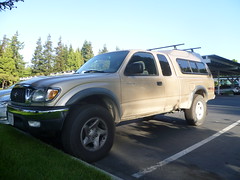
So, we bought Jack (our pick up truck) with a very specific purpose in mind.
Okay, not that specific, but basically, we wanted to make him into a sortof - very basic off-road camper. Jack is to campers as ultralight backpacking is to traditional backpacking.

http://www.swaygogear.com/articles/truckcamping/
But, we had a few ideas of our own. In particular, we wanted something where we could easilly use the truck as... well... a truck. In our current lifestyle we are not nomadic, so this conversion needs to be dual purpose. That said, we have a lot of gear that we want to keep in the truck basically all of the time. Examples include basic repair and recovery gear for the truck, and some simple camping gear.
See Jack the Truck for the planned list.
So, we devised the idea of building boxes down the sides about the size of the wheel-wells. I designed something, went out and bought the wood. While discussing it Jess thought she had a better idea and designed something somewhat lighter. We went back and forth and after a few iterations (and a bit of bickering) mostly had something we were happy with - with Jess making a few more modifications during construction.
And here is the result:
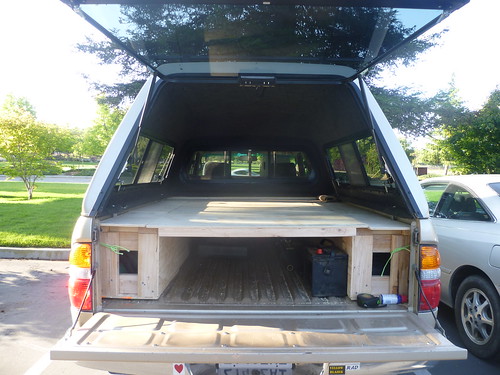
The boxes are screwed together with coated deck-screws. They're built of 2x4 and 2x2. All the ply is 1/4". You can see from the photo how the end is constructed - a simple cross-brace. This was Jess' idea to make them super-sturdy without too much extra weight.
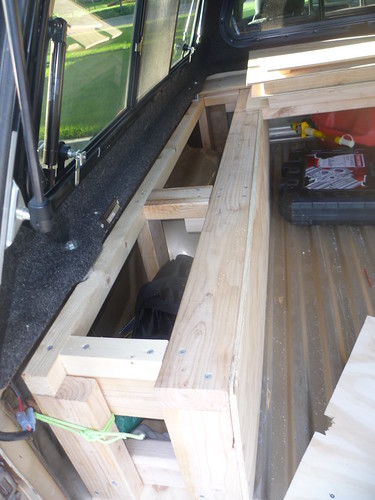
Here you can see that the inside top of the box is 2x4 and the outside is 2x2. We wanted plenty of lap space for the ply top on the 2x4 so that the boxes could have a little "play" in terms of bed position without the panels we're lying on dropping to the floor. This necessitated the slightly complex construction of the center cross piece screwed into a block, as we didn't want to waste the extra weight of a more complete support structure
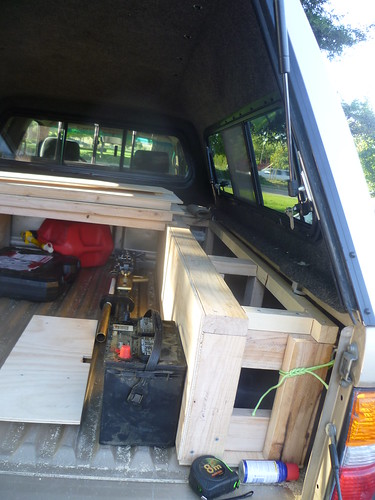
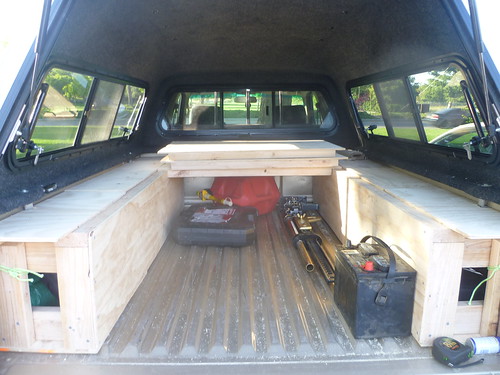
In the end we're really happy with how the rig came out. You can see it's pretty easy to get into the boxes from lying on the platform. The lids have pieces of wood on the bottom, so they're held somewhat in place. Moving the platorms aside is trivial, they slide fairly freely down the "tracks" made by the boxes.
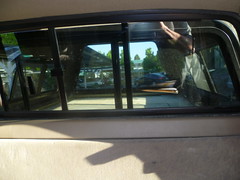
Removing the front window it's possible to get from the cap to the cab without leaving the truck, it's suboptimal, but possible. After much research and consideration we decided a "boot" connecting the cab to the cap was a bad idea, and that we could live with this setup.
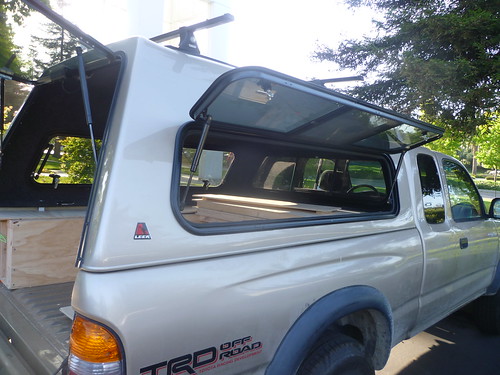
Future improvements:
-
Velcro edged black velvety cloth to hang over the windows. The hope is that in the dark or if no-one looks too closely it'll read as heavily tinted windows. This is both for "stealth" camping, as well as general purpose curtains.
-
Velco edging on the lids. The idea is to velcro down the lids with a layer between the box and lid so that they don't rattle and bounce around while we're driving, especially useful on rutted dirt roads.
- Improved tie-downs. Right now the boxes are tied in place on each cover to the bed tie-downs with heavy twine. This is okay - but something a bit heftier like webbing would be better.
- Some form of mattress or pad either rollable, foldable, or attached individually to each panel. We haven't decided yet, so we'll just use backpacking matts for the time being.
More photos
Jack the truck
2011-05-04
- we could sleep in
- could carry 4 people
- could carry a decent amount of additional gear
- got ~20mpg or better
- was relatively offroad capable - since we're using it primarily to get out to trailheads and such.
- 150 piece socket set
- vacume pump (for doing hydrolics. I purchased this for changing the brake fluid alone)
- high-lift jack (I got this for getting unstuck, since I know I will)
- gas tank (so we can carry extra when we're heading far out)
- tire repair kit (including compressor)
- tow straps (combine with highlift to create an ad-hoc winch, and we can pull out other cars directly... Jack has a 5k lb tow capacity)
- D-shackles (they go with the tow straps)
- D-shackle hitch (ditto)
- OBDII -> bluetooth doohicky (this lets me see what the computer is doing)
- 1 set tire chains (needed for tahoe, useful for mud)
- Locking pliers
- electrical pliers
- wire strippers
- hack-saw
- WD-40
- Crescent wrench and a few other random tools
- 10x12 ft tarp (ad-hoc shelter, and 100 other uses)
- various power adapters (to power cellphones etc.)
- my 3-channel Ham radio (emergency help, can do CB as well)
- small hatchet (hammering things, and clearing trees)
- folding bow-saw (clearing trees - say one falls behind you while your out)
- zip ties
- duck-tape