

Slinging
2011-03-17
Gear Review: Montane Windpants
2010-12-29
When I was first lightening up my backpack load I was doing research into various types of gear. At the time the idea of water resistant clothing for rain (rather than water-proof) was pretty hot. I read several articles and decided I'd give it a try.
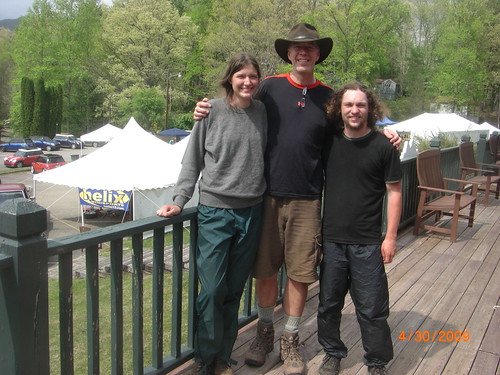
(I'm on the right, in the black wind-pants and black tee-shirt)
So, anyone who claims thin Pertex pants aren't sufficiently tough, is going on instinct, and hasn't really tested them. They have a downside of course, they are not waterproof. Basically, they do everything rain-pants do, and do it better, except for stop water :P.
One final note: Going up in the Sierra on edge-seasons and winter has changed my use-case a lot. I just got a pair of water-proof breathable rain-pants. We'll see how that works out - Stay tuned :P.
A tangled tail: Hair care for the trail
2010-12-29
To prefix this let me explain to you that I have demon hair. It's fine and thick, down to my butt, and likes nothing so much as to tangle into an impenetrable mat. It's the kind of situation that makes you eye the scissors.
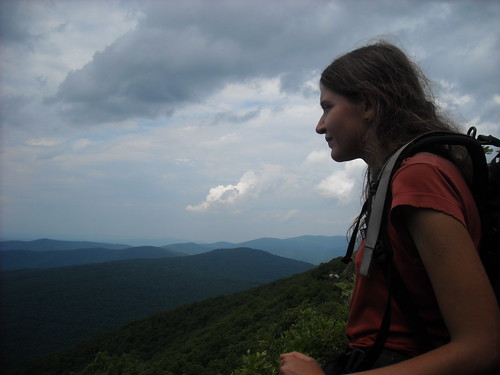
But I'm a hiker, so for years I just muscled through it. The modus operandi was throw it in a braid, hike, then spend the next week slowly coaxing sticks and knots out of my hair until I had a giant, but clean, frizz-ball. When I decided to thru-hike the Appalachian Trail* I was pretty sure I'd just have to shave my head at the end.
About a week into the hike I first tried to brush my hair. It was a disaster. Two hours of brushing with my tiny brush left a lot of knots, a sore scalp, and was just discouraging as to the future of my hair. In short it was what I'd experienced coming back from every trip I'd gone on. Shaving loomed. Two weeks later I had another chance to shower and something magical happened. This time I didn't bother with the pre-shower brush-out. Instead I just jumped in and finger-combed out my filthy hair before washing it. It took awhile, but I was able to work out almost all the knots. It only got better from there on out too. In fact, while on the trail, my hair got longer for the first time in years: it was enjoying this neglect!
The difference? My hair was dirty. Filthy even. Impossible you say! That could only make it worse. Not true. If you stop and think about it dirty hair means each strand is coated in oil, which will help keep it separated from its neighbors. The best way I've found to set up this lovely knot-repelling oil-coated situation before getting into the woods is simply to not wash my hair for as long as possible. Of course just ignoring it would cause many of the same problems as starting a backpacking trip with clean hair, so what I do instead is brush my hair out in the shower every day, but skip the washing step. This helps keep the hair separated and distributes the oil evenly throughout. Obviously this oil can pick up dirt and eventually become downright disgusting, but that takes several weeks. While hiking, washing lightly every week or week and a half is enough to keep me out of the disgusting zone without resulting in inhuman attack knots.
Everyone's body chemistry is different, but if you've considered head shaving due to backpacking then washing it a little less often might just be the key.
* Note: I decided I'd do the whole thing. While hiking I decided to only do 1,000 miles (2.5 months) to allow time to try farming that summer as well. I can't wait to do the other half.
Practicing being a hyperactive child: Parkour
2010-12-25
So. Jess and I like to fool around with Parkour occasionally. The name parkour (as most know) is a french martial art. For more on Parkour see the
Wikipedia article
. Recently it's gotten some play in the media, but it's been around for a while longer. Many have tried hard to keep it from association with gangs (as jams really aren't gangs in any classic sense, and are usually polite, friendly, ad-hoc, and non confrontational), but probably the strongest adopters have been street artist groups.
I've always loved jumping on things. Sometime in college I discovered my friends did too, and we started playing with wall running (running up a vertical wall as far as you can), jumping up and down flights of stairs as far as we could, doing standing jumps from one wall on a walkway to another - etc. Basically, think of anything a hyperactive child that's always covered in bruises would do... we did that.
Not long into that I discovered people who were really good at this stuff called the collection of all of it "Parkour". The flashier forms of it are called "Free Running". Having a name for it meant I could find information about it on the internet, and pretty soon I saw cool things people were doing. Thing is, I still had no idea how to do much of it.
Jess moved to Seattle, and so did a friend of ours Tom. Well, in Seattle they ran into Parkour jams, and thought this was the best idea ever.
The way people practice parkour is pretty different from other sports. The sport itself is very individual, and non-competitive, but to learn new things and work out how to do things (that is, to get "beta" in climbing parlance) it's often practiced in groups. It's also just way more freaking fun with others, and it's good to have someone to call an ambulance when you fuck up. That said it's not exactly an organized sport either. So there's what's called a "Parkour Jam".
So, recently we've been working on several motions. I started playing with wall-running and jumping up and down stairs in college. Tom and Jess learned cat-hangs in Seattle, and through a number of inputs we've learned the basic vaults. Speed vault, lazy vault, and catch vault, and now we've been working on the more advanced monkey vault. My follow-through is still poor and I catch my feet sometimes, but I can vault crossways over a picknick table now.
We've also been working on shoulder rolls, I'm trying to get mine reliable enough to use on pavement. I can now do a dive over a bench or similar and come up well. We've recently been playing a lot with monkey-bars and trying to "run" smoothly with your arms hanging under the bars, without the body swaying backwards and forwards.
Parkour can broadly be broken up into 3 classes of activity. Running, Jumping, Climbing.
- Running is of course, running, except possibly over very uneven surfaces and similar.
- Climbing - This includes quadrapedal motion, balancing, cat hangs, and of course... climbing
- Jumping is the flashy stuff, doing vaults (jumping over things), drops (jumping off things), wall runs (running up things) etc.
For definitions and background the Wikipedia page (
http://en.wikipedia.org/wiki/Parkour
) is pretty good.
I won't say that I haven't hurt myself. Not long ago I was walking across a train platform and went to vault a railing. I did a catch-vault (where your foot hits the rail). I was wearing very different shoes than usual though, and my foot slipped off backwards. I had forward momentum so was flipped over by the rail. With my head quickly approaching the cement, I threw my arms down as if to drop into a shoulder roll - but, my foot was a bit caught on the rail, and I had a bag on my shoulder so the roll failed, and I didn't flip early enough to land on my shoulder. Instead, after absorbing most of the fall with my arms, my head (a bit backwards from my temple) contacted the cement.
My first thought was "crap, my head hit... this is really bad". I lay on my back flat without moving to see if a headache came. I touched my hand to my forehead, no blood. Okay. My friends said my eyes were dilating, and I pointed out I was looking directly up into a street lamp :P. It turned out I was fine, just a minor impact. I only had a headache for about an hour, but it scared me... a lot - and reminded me to be careful.
Now that I've scared you a bit, here's the thing, most of these activities are not terribly dangerous, it's all about working your way up slowly. What I was doing when I slipped was just jumping a railing, something any teenage kid would do. Having done parkour meant I pulled out of it fine, because I'd practiced rolls. In other words, I wasn't injured because of parkour, as much as I was injured because of parkour.
Be aware and informed of the risks of course. Most importantly don't start by trying to do a monkey vault over a 4 foot high 4 foot wide block of concrete. Instead start by doing a monkey-vault on grass, over nothing. Start with just the dive and absorbing it in your arms. Then do a frog hop until you feel confident and comfortable, etc. The key to not getting badly injured is learning how to work up slowly on any given activity. This is true of ALL sports, and something people who do sports a lot often forget when they switch - but it's doubly true when the consequences of a significant screw-up are your head impacting concrete at high velocity. Once a major screwup is coming in at slightly the wrong angle, or your hand being rotated a few degrees the wrong way - you can make several and still be okay. If that's true at all stages, the activity should be relatively safe (adjust to your own standards of course).
I highly recommend trying it, much of it can be done very safely. Maybe someday you'll find yourself jumping off 2 story buildings, and maybe not - either way doing a shoulder roll on the grass is a lot of fun now :P.
Yosemite and hail (a tail of fun, despite minor disasters)
2010-11-29

So. Jess and I went to plan a trip.
The trip was from October 2'nd to October 10'th
Planning
We wanted to go for 9 days. We had a couple of places in mind: the lost coast or the Sierra. I poked around for weather a bit (looking up local weather patterns, and computing what elevations should be within our gear, and still have a margin of safety), and the conclusion was either was viable. The Sierra would be a bit cold, and we may have to avoid going to high (our gear goes to 10F right now, and we like to have 5-10 degrees of slop in case of freak weather or being wet or sick or whatever), but that could be interesting. We decided we wanted to go near Yosemite, up in the Sierra, and we wanted to be out for about 9 days. So we grabbed a map (topo of the entire Sierra, we'd picked it up a couple of months prior on a whim) and started looking at interesting areas.
We looked at how we might get there, and get back. Figuring we could get a hitch out of Yosemite easily we figured that was a good endpoint. Also, that way we wouldn't have to deal with getting a permit there, which we'd heard could be a bit harder than other places.
After some looking at the area, we figured 100 miles north would be good, if we could get there. Jess did the legwork and found out Amtrack with bus+train could get us out of Yosemite valley in an entirely reasonable amount of time... awesome!
We both posted to a mailing list or two, hoping to find someone going out to where we wanted to get dropped off. I realized I could loosen the constraint and asked for anyone going within 100 miles of Yosemite. Surprisingly, no bites. Okay... We could rent a car, but that's silly for 9 days with only 2 of driving. Eventually someone *did* respond pointing out that permits are easy to get from Yosemite this particular season. Okay then why not just grab the train in to Yosemite? It means doing a loop which is psychologically different, but we decided that was okay.
This was an edge-season trip, a bit colder than we're used to, in an geographical area neither of us are experienced with. So the weekend prior we ran over our gear to make sure we had what was needed. I lost my rain-coat a while back, so I did some quick testing of my experimental tyvek raingear and sealed my hat to make it a rain-hat. We got Jess some waterproof socks, and after I failed to acquire boots that fit, I ran out and bought a pair of exactly what I wore for 800 miles of the AT. We ran about and packed gear and food in the evening the 2 days before. Usually we can pack all our gear in about 30 minutes, but this trip took a lot of thought - we hadn't even needed rain-gear in months.
Extra gear we grabbed (over say... AT gear) included:
- Jess had an extra warm wool sweater-thing
- I had a pair of puffy pants, and silk tights in place of other warm tights
- We both had microspikes (almost crampons)
- We both had wool gloves/mittens
- some of our socks were extra-thick
- sunglasses (in case of snowfields)
- spin-cast fishing gear (because we were psyched about it)
- an extra sleepingpad each for added insulation in cold
Jess's Gear:
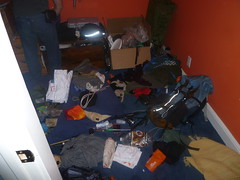
My Gear:
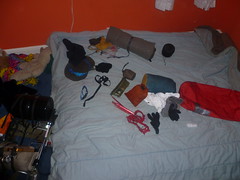
(We didn't carefully lay stuff out, Jess just snapped some shots while we were packing)
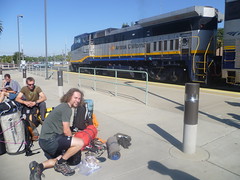
I should mention actually that we've been laughing and having a good time all this time :). Just cause it's raining and your near hypothermic is no reason to get depressed (though I was certainly a bit frustrated, and was getting a bit more snippy than usual).

Discretion is the better part of valor
Come morning most of my gear was dry, my bag was damp but not too bad, but my vest was completely soaked (it had gotten even wetter after falling off my bag in the night, and lying in melting hail. We realized that there was no way (given our skills) that we'd get the fire lit this morning. The hail had been side-blown during the night, coming in the front of our tarp, this would mean wood under logs would be soaked. It was also now below freezing, So the wood would be not only soaked, but frozen solid. Also, my rain gear still didn't work. We decided... maybe continuing was pretty dumb. It didn't look like the weather was going to suddenly clear. So we packed up and hiked to the nearest road (120).
I was changing to try and look a bit more reasonable (I had my silk long-underwear on the outside), when a large truck pulled up, and asked if we needed help. We said well... sortof. Our plan was to hitch down to the nearest place to buy fuel, and if we could find lighter sticks and rain-gear all the better - but we figured I'd be okay if I borrowed Jess' spare wool jacket (we discovered much later it was cotton actually), even if I got wet.
Well, the ranger informed us they were closing the road, so no-one else would be passing by. Also, he said it was supposed to keep hailing until the next Sunday (our entire trip). Lastly, he said that they were pulling all the rangers out of the backcountry because of the storm, it took everyone by surprise and the weather is changing really fast, very unpredictable. We looked at each other and considered. We almost turned down the hitch to stay in (since we couldn't get back), but the guy convinced us.
Turned out the ranger was responsible for the water system's around the park that feed waterfountains, spigots, bathrooms, etc. He does a lot of his work in september and early october when the rivers are still low, so he can get to the middle where the feeders to the systems are. This was the first significant precipitation of the year. He was pulling out from some repair work he'd been doing, the truck was full of tack for mules and a horse, as well as tons of water-processing gear (pumps and stuff). He told us stories about getting stuck and having to abandon mules because they won't walk on slick rocks, and get spooked by thunder, and we chatted about park politics and such. Well, there was no point in stopping just down the road, since we couldn't hitch back. He was heading to the valley, so we went with him all the way back.
Regroup
Back in the valley we dropped by the wilderness center so they'd know we were okay. We figured if they were pulling rangers they might also be counting up who was out there, and if it got worse thinking about how to get them out, so letting them know we were out and safe might be useful. We found a small tourist-oriented gearshop and bought some raingear (pants for Jess, full suit for me), fuel, and those magic light-wet sticks for starting fires. Then we wandered over to camp four. We did a bit of fishing in the river, messed about on the slacklines, and talked to the climbers (Jess and I both do a lot of indoor, still getting into outdoor, but camp four tends to collect the traveler's of all types anyway - lots of fun to talk to). We weren't sure what we were going to do, but were thinking we might just head out again the next day.
The next day we went back to the wilderness center with a newly planned route, ready to try again. We figured 5 days, heading south this time. The girl there put in 5 days, from the 5'th to the 10'th (that sound right to you?). We spent a LOT of milage wandering the valley and failing to find the trailhead. I got a bit frustrated (stupidly), but eventually we found it and started up the hill... YAY! It was actually sunny today too!
I was wearing my down-vest over my new rain-coat - drying it out with body-heat. By partway up the valley it was starting to actually get fluffy again (just a bit). By the time I took it off due to overheating it was actually adding warmth again. YAY! Beautiful views all day
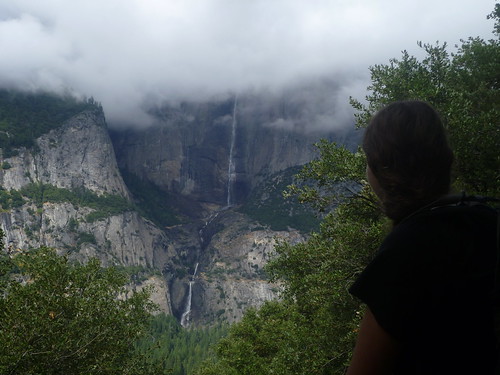
We *still* got hailed on :P. But that was fine. On the way up we heard rumors of a mountain lion. Instead though we saw a mother bear and her 2 cubs. Pretty cool!
At the top of the hill it turns out there's an outlook you can drive to with a view of half-dome. We grabbed some food and met some neat people. Got a few nice pictures. After a bit we saw rain coming in again and decided to hightail it to lower ground.
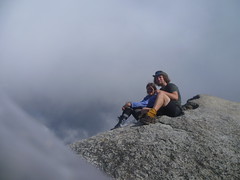

We didn't see anyone else after this. We walked down to the south. On the way we saw our second bear. This one was hiding in the bushes. Sadly, about this time (just as we get out of the area everyone goes to) our batteries for the camera died, so we don't have any more photos. Here's one of the last ones we got:
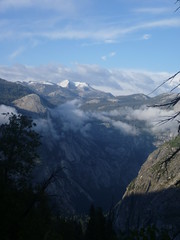
We camped by a pretty stream in a coniferous forest that night. Jess lit up the fire while I went fishing. I lost a lure, despite fording the river once to get it back... oh well. We had a hard time keeping the fire going, but we were learning, and we did manage to cook our dinner on it. Generally a pleasant evening.
Next morning we saw some boyscouts go by, but otherwise didn't see anyone. We set off towards our first lake for the trip. We weren't sure yet if we were going to go over the ~1300' pass, or just over the ~9200' pass. The milage that day took us a LONG time. we were climbing to 9200 from about 6000 (we'd dropped about 1200 since the overlook). Turns out climbing greater than 3000' for 2 days, one days rest (while cold) and then doing it again, all with a good amount of weight, is pretty hard. Well, it was getting dark, but I really wanted to make it to the lake. Jess was starting to have problems with her leg. It's snowing on us. We hadn't seen any landmarks at all for miles, and were beginning to think we might've taken a wrong turn. After dark, FINALLY we come apon the trail intersection we were looking for. I get ready to dive off into the woods to search for the lake, but with some effort Jess convinces me that that's a really stupid idea, I concede sulkily and we find a spot in the snow and set up camp. Once again, a pretty nice evening.
Next morning, Jess is having trouble walking. We never do find the first lake, but that's okay. We definitely do NOT want to go higher than we are now, given that it's snowing and we already pushed our luck once this trip. So we set off the other direction. Jess is having problems lifting her leg, eventually I prevail apon her to let me take some weight... then more weight. I also gave her my hiking poles. So, now I'm carrying all of the food, and a bit of her gear. 2 full bear-canisters strapped to my pack (a pretty hilarious sight, to bad I the camera was dead). I'm still out-hiking her a bit. She's moving along though. We're near the farthest planned point in our trip, so backtracking doesn't have much point. So we push forward, looking for routes that might reduce our hill climbing (hill climbing requiring her to lift her leg). Throughout the day (and the evening prior) we'd been following just one set of footprints in the snow, eventually we caught up with the actual guy who made those prints and talked to him a bit. He had a huge pack, lots of weight. We set off again and see no prints for some time. Eventually though we do run across another set of footprints, and not long after meet that guy going the other way - he was doing a 30 mile dayhike. Those are all of the prints we see all day.
We get to another lake fairly early that night. We set up camp. I go fishing and catch 2 fish with only 8 casts... awesome! I hadn't cleaned a fish before actually, but I'd seen Brian do it on our dinky lakes trip. After a bit more torturing of my poor prey than I'd like, I figure out how to do it (and how to reduce the torture next time... tip, start by severing the spinal column just behind the head. That column contains the blood supply to the brain and the nerves, so your fishy friend will die fast, painlessly, and without twitching.)
We sleep FAR from where I cleaned the fish, being afraid of bears. In the morning we discover we camped fairly near someone else (who'd tented earlier in the evening, and come in from the opposite direction). He gave us some tips on how best to get out without stressing Jess' leg. We also talked a bit about how things go wrong on trips. He had had accidentally slept on his byte-valve and drained 2 liters of water into his bivy the night prior and had been drying all his gear since sunup. Oops! We'd begun to wonder if it was only us that always had problems, apparently not.
That morning we were getting nervous about getting out. We've got too much food. WAY too much food. Jess is having trouble walking. We start considering burying some of the food. It's not very friendly to the ecosystem - but it's better than calling SAR to get Jess out because she can't walk... or to get me out due to a knee injury from carrying too much weight down hill. While we're considering this, we're trying to count days... suddenly we realize we're off by a day! We STILL have too much food, but no-where near as much too much. YAY! We could hang out here and let Jess leg heal - but it's not clear that it won't be *worse* tomorrow. So we decide we should just make our way out slowly, splitting the mileage as evenly as we can across the days - but getting in the day before we have to leave so we don't have to worry about speed while descending. We pack up and head out.
The rest of the trip was relatively uneventful. Beautiful views, Jess limping along (lifting her leg with her hands at times), but doing fine. I'm hauling my huge pack, but also not having problems. We saw one more bear, just a cub this time. My knees held up through the entire descent, no problem. We came down via the waterfalls and half-dome trail. MAN that was a lot of people... oh well, pretty anyway :).
We slept at the "backpackers camp" which took us a LONG time to find. There are *no* signs for it in the valley. You have to go to the wilderness center, and even their directions can be tricky. None of the normal campers have any clue it even exists... That's all pretty cool actually, but it does mean you have to work a bit to find it. We had it marked our our map (not one of the valley, one of all of yosemite) and found it that way.
Overall it was an awesome trip. Yes we had some disasters, but we had a great time anyway, we recovered well from the problems, we bailed when we needed to and we were never in any real danger. This trip had been a bit of an experiment in edge seasons, and we learned a lot. We also learned a lot about starting fires in wet weather, and such. Jess' leg problems appear to have been a simple overuse injury (tendon damage, which heals fine, but slowly). She hadn't done that long uphills before, and certainly not with that kind of weight, we assume that was the problem - so we'll be more careful about that in the future.
more photos: http://www.flickr.com/photos/smalladventures/sets/72157625184424068/