

Flying without ID
2010-11-29
I lost my last piece of valid ID the weekend before thanksgiving, and so got stuck flying without ID to and from Texas to see my grandparents. I was nervous before hand, so I shoved every piece of offical and unoffical documentation I had in my luggage. I had photocopies of the lost ids, my social security card, my birth certificate, expired passports and miltary ids... basically everything.
When I went to get on the flight at SFO in San Francisco they looked at my checkcard which has a very fuzzy picture on it from high school and my miltary id which expired 14 years ago. They guy checking ID said it was better than just a driver's license and I didn't get any extra screening.
On the way back from Texas I ran into a little bit more trouble. The lady checking IDs told me I really should have returned the expired ID to the government and requested my health insurance card in addition to the check card and military ID. After that I was pulled aside for additional special screening. Talking with the lady doing the screening however I found out I'd gotten the new enhanced pat down due to wearing a floor length skirt, and not due to any issues with ID. As a note the lady doing the pat down was suprisingly profesional and seemed somwhat embarsed to have to do this to people. Quite a neat lady in general.
In conclusion: Flying without valid government issued ID is not an issue, though the standards are inconsistant. Skirts are much more of an issue.
Building a Wickiup
2010-11-22
Well, In particular Jess got me a Kukri - and I really wanted to play with it (I.E. hack at something). What better test it than to build a pole Wickiup! The plan was simple. We'd go up to Mendocino National Forest, possibly try several areas until we found a good stop to build one, and then start building. We've been wanting a consistent area to go to to try and learn, so we have the option to spend more time doing bush-crafty things and less time "backpacking".
The wickiup we planned to build is a small temporary structure, we're not removing wood from the forest (just moving it around), and we figured we'd only use deadwood to do it. A quick scan of the regulations we could find and based on reading other's experienced, it seems fine to just do it - so we did.
We rented a compact car as usual and did a few drifts on our way up (aveo has nice clearance, never hit the bumper). We had an idea for a spot, so we drove there and slept by the road that night (it's fall, so it was dark by the time we left home, much less got to our spot). We set up a tarp to ward off the dew and went to sleep.

After some quick oatmeal cooked on the wood-stove we got moving up the river valley we'd selected. We picked a side of the river based on the pine forests on that side - thinking it would be easier to build there. After walking down it a bit we realized this was a poor choice. The early morning sun was on the other side (meaning much more warm and pleasant mornings) and the road ran too close on this side. So we walked back to the road and circled around again. We walked back in on the other side, intentionally skirting the line between the meadow and the forest. This, we reasoned, should be the line between the cold-damp air affected by humidity from the river, and the dryer and thus warmer air farther away. A few excursions into the woods proved this theory out. We needed timber from the forest, which grows in the humidity of the river - but we wanted to build our structure in the dry air. The closer to the line we built though, the less work, and the less distance to the river to collect water.
We soon found a nice spot, but kept scouting for a bit anyway. We found a better one, then a better one. Then we found something that was just beautiful. A gorgeous view of the valley, a dry spot to build, just above a nice damp forest filled with lots of small pine, large standard oak, and huge manzanita, live oak, and madrone (we'd never seen a madrone grove before, pretty cool). There was only one problem. Between the forest and the spot we wanted to build was what amounted to a cliff.
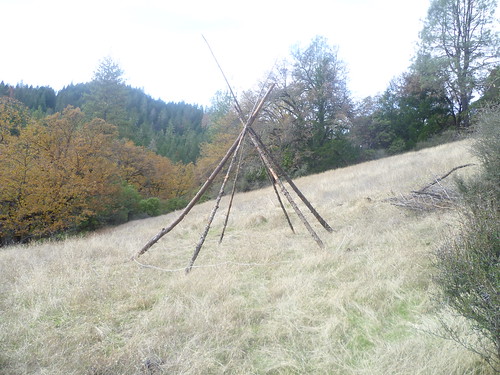
Oh well, we picked an exact spot, and headed down to the forest to start pulling out logs. We were looking for ~12 foot logs, for ~10 foot diameter shelter. We knew 14' would make 12' diameter shelter, so a bit of loose geometry says ~11.7' gives 10'. We wanted extra solid ones at the start - meaning not rotten, and large. This proved difficult. We eventually found some and hauled them up though. We didn't end up with convenient forks, so decided to cheat. We used a piece of nylon twine we'd brought (we could've made it, but that'd slow down the project) and lashed the 3 logs in a bundle at one end with a straight double-constrictor knot, finished with an overhand. We then stood it up and seperated the legs - it took some futzing to get the largest one in the right spot and such, but Jess figured it out and it all worked. The photo has the other logs we'd gathered in the process of finding our base added in as well.
Now, all we needed was a LOT more logs, longer at first, then as the top filled in we could fill in the bottom with shorter ones. So we set to work. After about half a day of limbing, hauling, and carefully standing up logs, we were exhausted. I could barely unbend my pinky - it turns out my pinky does a LOT of work to keep the kukri in my hand. Jess had been using a hatchet I found on the A.T. that had never been sharpened except with what I could do on a rock in an hour or so (not much... I've only sharpened an axe a few times, and it started scalloped by the previous user). By this time jess' shoulder was shot. I'd also ripped the skin off my palm earlier that week, so the new skin kept cracking, splitting and tearing. So after a bit of lunch, a trip to the river to check it out and replenish water, and a bit more log hauling, we decided to quit for the day.
Instead, we dug a nice fire pit in our shelter (a little forwards of the center). We had a nice fire going quickly using a sparker, and started roasting a gigantic pine-cone that came from a tree right next to the shelter.
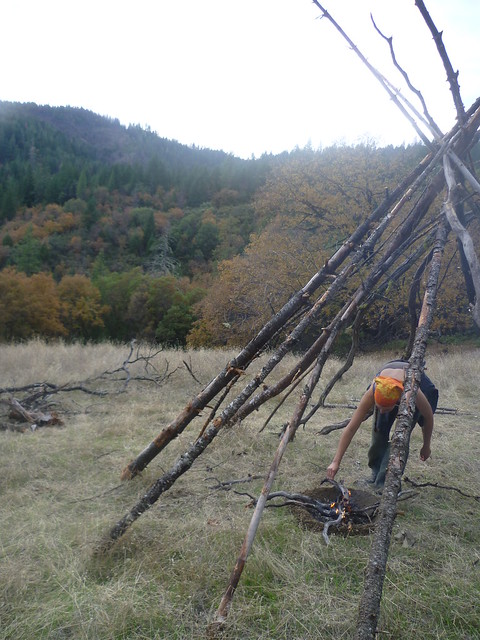
We made a bit of dinner (the pine-nuts were huge and delicious), then started thinking about sleeping accommodations. Our shelter was on a bit of a slope, so we started trying to dig it out and flatten out a platform by digging in one end, and moving the resulting dirt to the other end. We carefully did this a bit away from the fire, but with enough space to sleep 2. We also made sure to leave room for firewood near the fire, and for a space to enter the shelter. After a while we had something relatively flat (close enough for now anyway). Then we realized our sleepingbags would get all dirty; plus, we needed something cushy to keep us off the ground - otherwise we'd be cold like the night before.
Jess had the idea of gathering "straw" I.E. old grass, and laying that in as a bed. So we spent a while gathering some nice grass, and piling it up carefully as our bed. Jess put 4 sticks upright a bit from the fire to help keep us from pushing the bedding into the fire - that would suck. I wrapped the tarp around the shelter on the windward side to reduce dew. Then we curled up for a pleasant evening.
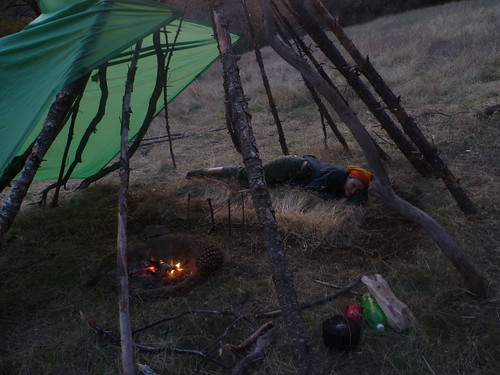
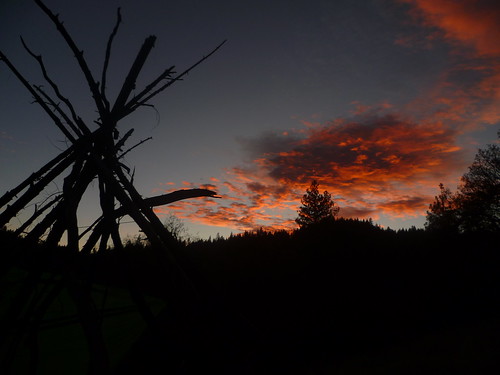
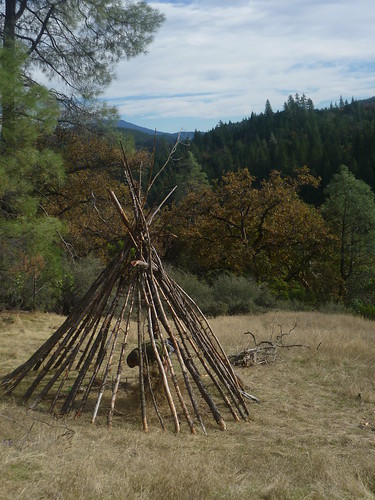
The door is on the far side - to face the morning sun. We clearly still need about as many logs as we have now again, but what's needed is getting smaller and smaller. By the time we stopped we were starting to use pine branches and such, not just trunks.
Feeling quite accomplished, and sufficiently sore, we cooked lunch over the fire again (olive bread, cheese, and lintel soup - amazing) and explored the area a bit more. Interestingly, a large madrone nearby had a LOT of claw marks. As we looked we saw several madrone with some claw marks. We'd noticed some earlier, but hadn't fully investigated. Down in the valley when gathering water we'd noticed a strong bear-scent, (there was some deer scent as well, but not as much). We'd also seen bear scat around. Still - I hadn't mostly seen bears tear up trees that much just to climb them. These weren't rotted. We began to wonder if maybe we were in a mountain lion's territory.
Anyway, we packed up and headed home, feeling satisfied. We plan to go back and finish it as soon as we get another free weekend.
Note that this is called a "Pole" wickiup. The idea is to pile lots of poles on, until you basically have a solid wall. Then you cover this with grass or pine-boughs or similar, then cover that with duff, then more pine-boughs, then some more poles to hold those on. The duff sandwiched in there creates a relatively waterproof layer.
On a side-note, think about what gear we used after the first night.
- Hatchet and Kukri
- sleepingbags
- tarp
- twine
- clothing on our backs + wool sweaters
- sparker
- water bottles
- book (In case we wanted to double-check something)
- cookpot and utensils
- knife each
- backpacks to put it all in
Update: Here's some more pictures of the wikiup further along
MYOG: External Framepack Mod
2010-10-17
MYOG is usually "make your own gear".
Well, this is "modify your own gear". A while ago I
posted
about some awesome backpacks we got cheaply. I've been using one of those packs ever since, and I've found one really annoying "flaw".
Modifications
Here's the backpack. I've been using the one on the right.

The "flaw" is those two pipes that stick up above my shoulders. I usually use the pack my strapping 3 bags to it, each between one set of horizantal bars. My sleepingbag in a stuffsack on the bottom, my ursack full of food in the middle, and a drysack with my gear in it on the top (sometimes those to are swapped). I also have 2 water-bottle holders lashed on, and I often tie my hatchet to the frame or clip on a knife.
Anyway, I never use those two pipes, and when bushwhacking in heavy brush, they catch on low branches constantly, and keep me from ducking fallen logs.

Well The pack on the left has bars going across between those posts (see above) - these bars hit my head, and at least vaguely annoy almost anyone who uses the pack. The pack on the left is also quite common, the one on the right is rare (I believe older, and made for a shorter period of time). So, I figured why not remove the top from the annoying pack entirely, and save the rarer pack that's more comfy for use by others. So, I moved the sack back onto the frame on the right (where it came from originally), and also swapped all of the other pieces as well, since I liked the padding and such on the frame I'd been using. In particular it has padding on the lower cloth panel, this padding keeps the panel from bunching and makes it far more comfortable.
I then hacksawed the top segment off the pack with the cross-bars on the top. I pulled the caps off and stuck them into the stubs I'd left level with the wields (to avoid weakening the pack). And... voila! an awesome pack that won't catch on trees anymore!
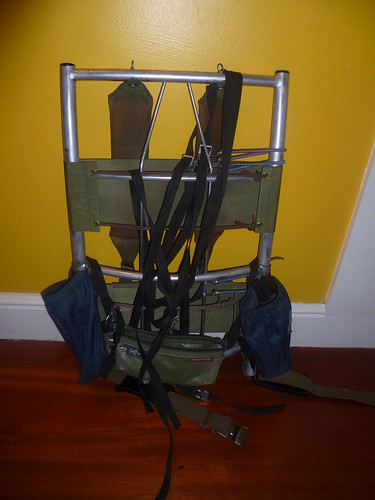
Success
I would not call this a completely unmitigated success, but I do really like the back. I've now used this on a couple of short trips, as well as one longer trip with a lot more weight (up in Yosemite) recently.
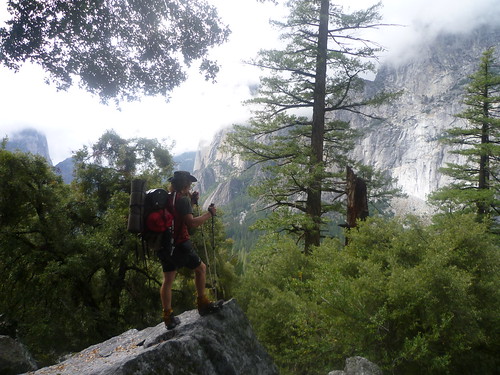
Advantages:
- Easy to carry extra gear (like an extra bear-canister), adjusts to varying loads well.
- Very good balance (holds gear close to back) and weight distribution
- Still low/small enough for bushwhacking
- Lighter than anything else with full-frame support
- Can hack it to be whatever you like, add pockets, gear, etc.
- Cheap ($2.50 plus straps)
- Simple, easy to hack, easy to build, easy to replace, easy to repair
- Easier to see what you are carrying
- Anything you want can be easy to get to
- It's cool! (literally, good ventilation)
- Takes longer to pack in the morning than an internal
- Getting to something from the "bottom" of the gear-sack is slow
- Heavier than ultralight semi-frameless internal options
- No sack to take the brunt of blows (I tore the drysack, despite it being tough)
- Gear can fall off (unless you're good with knots/straps/etc.)
- More lumpy/ungainly (so harder for lowering down cliffs, caving, etc.)
- Easier to see what you are carrying
I've now used it bushwhacking (old frame, before I took the bars off the top), except those bars it worked really well. The only problem I ran into was that I tore the drysack (which was on the top at the time) catching it on a tree-branch. Note that this was bushwhacking down a 45 degree drainage through dense manzanita and live oak (I.E. unless your crazy, you won't do this).
I've also carried upwards of 50 lbs in the pack (Jess hurt her leg, so I was carrying all the food, 2 bear canisters full). The original hipbelt, which I'm still using, caused some problems. The latch slipped with that much weight (though a hair-tie helped hold it), and the belt cut into my hip enough to start putting my legs to sleep. Not too badly, but I wouldn't plan to use the pack with that much weight, without a new hipbelt. I'll probably pick up a better hipbelt at some point (you can ask REI to order you a belt for one of their standard packs, I did this once to get a women's belt for Jess, for her old external).
When carrying that much weight, it would've been nice to have the 2 verticals still there, so I could put the second bear-canister up there (rather than slung on the back). That would've let me stand more upright - but that's not my usual usage, so I'm okay with leaning over a bit in the extreme case.
It's not perfect, but it works well. This is definitely an option to keep in mind if you want to go light, but have back problems. The frame is extremely comfortable, the straps are all replaceable, so if they aren't comfy you're not doing it right. It's not for everyone or every situation - but it it's another option that is surprisingly unexplored.
Backpacking trip: Sierra, Dinkey Lakes Region
2010-10-17
Summary
On this trip we learned:
-
GPS and a HAM randio can be useful in the back-country
-
We learn once again that you can get a tiny car down a lot of 4x4 only roads.
-
Wood stoves are awesome.
-
Fishing in the Sierras is awesome, enough that I plan to buy and carry fishing gear.
-
Slingshots are an awesome idea for opportunistic small game hunting.
-
Esbit is aweful and basically useless.
-
Gooseberry/currents are delicious.
-
Bushwhacking in the Sierra is *easy*!
-
Heavy boots are rarely needed, 5-fingers win again.
-
Good friends you can learn from - priceless :P (And sometimes they even catch you tasty fishes!)
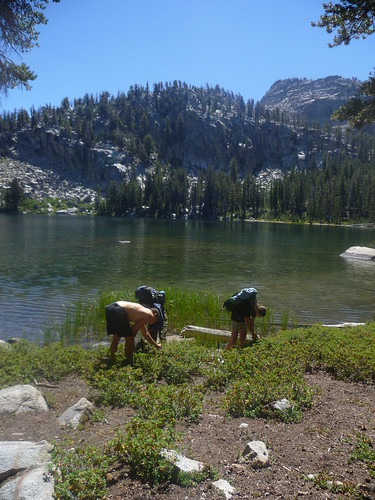
(Jess Felix and Lizza picking blueberries)
Details
How it happened
It was a 3-day weekend coming up, but I was going to be working on labor-day. Jess had planned to go on a bike-trip, and I was probably going to tag along for the first day and then head home. On thursday though a friend of ours, Lizza, contacted me asking if we wanted to go backpacking in the King's Canyon Area. On the same day, I ended up (maybe) with labor-day off.So, this was thursday, the plan was to meet up friday evening - 4 hours drive away. We had Thursday night to pack. Neither of us had been to this area, and we weren't sure when it rained up in the Sierra. Lizza sent us some data on temperatures that basically said it could drop to near freezing.
We got distracted Thursday night, and weren't packed at all come friday morning.
In the morning I got an email from a coworker which meant I had labor day off - so, the trip was on. In about 20 minutes we threw our standard gear in our packs. We both started backpacking on the east coast so our "standard gear" includes rain-gear, wool sweater, down vest, warm tights, wind pants (or similar), warm hat, extra socks, insulating sleeping mats, and 10F sleeping-bags. Scrounging a bit in the kitchen we got most of what we needed for food, with a very short list left to acquire (Gatorade and lunches).
We still had some logistics to figure out. I called Lizza and got details. We were meeting at a GPS point, at the intersection of a hard to identify tiny side-road off of a small back road. She has an HT radio for hang-gliding, and I have an HT because I'm a nerd with a HAM license. So, we figured out a frequency we could meet on if needed. I installed a bit of GPS software on my smartphone, and made sure to pack gear to power both the radio and phone off the cigarette lighter. I have a real GPS, which I should really learn to use for such purposes, but the phone was less effort this time.
I worked from home so I would have a bit more time to organize things and pick up a rental car (working from home saves me 2 hours commute time). I ran the numbers on zipcar, and several rental agencies. Zipcar is expensive in the summer, so they would've cost ~50% more in this case. We ended up with a Toyota yaris sedan from Hertz.
I still started working before my normal time. Then in the afternoon I quit a bit early as well and ran out to grab the food. Then I walked down to the rental place, got the car, drove back, got the gear, and drove down to pick up Jess. There I picked her up... and were off!
Getting There
Drive was uneventful. We stopped for food on the way. As a result Lizza, Brian and Felix beat us there. We found the point easily and they were waiting (it appeared that they hadn't been waiting long). We repacked and after some discussion concluded we should drive as far in as we could on the dirt (4wd only) roads... Note that I had a toyota yaris (a tiny economy car with poor entrance angle). By this time it was dark.Well, we drove in, and I didn't trash the car. I dropped the frame on a rock once after taking a larger one under the right wheel. Brian managed to get one wheel of his Honda element off the ground on a steep drop, but it was no biggy. We got in pretty late.
We then pulled out our packs and humped off into the woods. We slept at a nice place just a couple of miles in. That night it hit 26F according to a thermometer Lizza and Brian had brought. There was also significant condensation. Jess and my down bags are a little water resistant on the outside, my toes got cool because I hadn't been careful to put my heals on my sleepingpad, but I slept fine. Both our bags had significant frost on them come morning. Brian's bag was holofill stuff, but wasn't water resistant at all, and wasn't nearly so warm. He had spent a cold night. Lizza had a -30F bag and was happy (she likes to be very warm).
Hiking!
Day 1
Due to the nature of the trip Jess and I had packed independently of Brian, Lizza and Felix, and with little communication. Jess and I were, effectively, along for the ride, as Brian and Lizza had planned the trip. So, come morning, we all made our own breakfast.Lizza and Brian had made their own wood stoves! (apparently inspired by hearing about mine). So the 4 of us all fired up our wood stoves to make breakfast. I'll have to go into details another time, but their home-grown single-walled designs worked pretty well for having never been tested. There were minor airflow issues. Mine drafts a bit better than either of theirs, but they definitely worked. We also lit all 3 stoves with a spark from a "light-my-fire" sparker, using cattail fluff Jess had from our last trip. That was pretty exciting since Lizza and Brian had never done that before. We used a bit of dry grass from the edges of tufts as tinder, and the tips of dead pine-boughs as the next stage.
After breakfast we packed up and headed off. Due to planning time frame Jess and I lacked a map except for one of the *entire* sierra's (not very helpful), but Brian and Lizza had one. We headed for a lake. Beautiful! Incredible views, clear lakes. We were already at >9000 ft in elevation. We could feel the altitude in our breathing. We found a patch of blueberries and snacked. Brian had a tiny rod and reel that he pulled out. In a short time he'd caught 2 fish about 10 inches long, while the rest of us lazed around on the beach. Then we packed up and wandered off to another lake.
On the way we lost Felix for a bit. Brian pulled out a slingshot and was practicing his aim to kill time... this seemed like an awesome idea to me - it would be great for hunting squirrels and such. I tried throwing rocks, but my accuracy wasn't nearly as good.
We camped at another lake that evening. Brian went off to fish while the rest of us went swimming and gathered wood. As there was no fire-wood by the lake, Lizza and I ran off up the hill - which turned out to be HARD at 9000 ft! I'm used to bounding up a hill for several hundred meters without any issue, and being able to regain my breath in a few seconds - not so much at 9000 ft. Jess is always a slower uphill hiker (but able to kick almost anyone's butt on a good downhill). Her limitation is cardiovascular+lungs. Up there when you work hard you can hear your heart beating in your ears. She'd been noticing the altitude strongly all day, where it only came up for me when I tried to burst.
Brian caught 2 more fish. We lit up a fire. All the wood was from various pine'ish trees. So it was going to burn fast and we needed a lot. We again lit the fire with a spark using cattail fluff and had it going in no-time. We cooked dinner, including the 4 fish. Dinner was amazing as everyone cooked up what they had and we just shared it around - nothing like a 5-course meal including fresh-fish, at 9000 feet on the edge of an alpine lake in the middle of nowhere.
For dinner we had several things. Fish, which had been slit on the sides and salt and various types of pepper rubbed in. They were then stuck on a 2-tined metal thing that fits on the end of a stick and roasted over the fire. Jess and I cooked vegetarian split pea soup with couscous added. It was actually very tasty, just slightly bland. Lizza, Brian, and Felix had brought some backpackers pantry which was pretty good.
Lizza had carried in some Esbit tablets. Esbit is a burnable tablet for cooking, it's supposedly light to carry and easy to use. She had 2 types. Lizza tried to boil a liter and after 8 gave up (this is at 9000 feet, BTW). Our conclusion is that Esbit is heavier than alcohol per pot of water boiled, and more annoying. It even required a better windscreen than the alcohol did. We were stumped as to how or why anyone would ever use it.
Day 2
Next morning Jess and I got up late'ish. Due to the dew problems on the first morning, we'd slept under a diamond pitched tarp, but there was no dew this morning. I had woken up at dawn, glanced around, and seeing no-one up gone back to sleep. I did this a few times. It turns out Brian had snuck off to fish, and Lizza had snuck off for a morning walk.Out of curiousity I tried the Esbit, and managed to boil 3 cups of water, but it required 5 Esbit tablets. This was on the bottom of my flipped-over pepsi-can stove, inside my woodstove (so it had perfect airflow). The apparent uselessness of Esbit stood.
We cooked up breakfast. Brian ate the 2 fish he'd caught before we got up. Lizza and Felix had relit the fire already so we cooked everything on it. Jess and I had oatmeal again. We extinguished the fire, and picked a route past a couple more lakes that involved a couple of miles of bushwhacking. The bushwhacking was glorious. The difference between this and even east-coast bushwhacking was night and day. You just walk, it's almost as easy as being on a trail. Compared to Mendocino National Forest (where going 100m could take you half an hour) it was like a dream. During our bushwhack we found what Lizza called Gooseberries. Jess looked them up later and says they're probably more like currents - but it looks like gooseberries and currents might be kind of like plants of the rhubis genus, in that there are arbitrary gradations in-between, and all interbreed. Apparently gooseberries are the more prickly ones, and the berries are oblong. In any case, they were delicious so we picked a pile and stored them away for later.
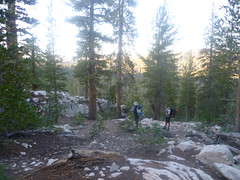

We missed our goal slightly on the bushwhack. Jess Brian and I were all sighting regularly with our compasses, Brian leading. We only missed by a short distance though, hitting a smaller (but very pretty lake). We figured it out based on topology and went the right direction. One HUGE difference between backpacking in the Sierra's and backpacking on the east coast or in low rolling hills is that you always know where you are in the Sierra. There are tons of landmarks, i.e. mountaintops and ridges of very specific and identifiable shape and size, such that you can just triangulate your position any time you need to. This was a totally new experience for both Jess and I who were used to dead-reckoning for long segments of a bushwhack.
At the lake we'd been heading for Brian caught several more fish while the rest of us mucked about, snacking and such. I was starting to burn a bit so I slathered on some mud, Jess as well (Brian and Lizza had brought long-sleeved clothing and sunscreen). Eventually we set off again, this time down a trail, heading for yet another lake nearer where we started, to make our trip out the next day a bit easier.
Well... we missed completely. We were flying, hiking at a really good pace. I was really enjoying stretching out my legs and took off in front in big strides, bounding down the rocks. As dusk was just starting to hit we reached a sign. Brian looked it up and found that we'd gone a *lot* farther than intended and in slightly the wrong direction. We'd lost the trail a bit once or twice and refound it. So, we probably missed an intersection during one of those. Jess and I sat down and ate food while Brian figured out what to do, and Felix got eaten by mosquitos (he was the only one). Brian suggested a lake that was only a mile bushwhack away. We thought that was fine. Everyone set off again.
Jess took a sighting and found a rocky mountain top only 1 degree off from our destination. We beelined for that, I just walked in the straightest line I could out front, towards that mountaintop - double-checking with the compass occasionally. We hit a high ridge-line eventually that ran up towards the mountain. Skirting this to the right we came up over and dropped down into a high valley, The lake had to be to our left (nearly behind the mountain), so we set off that way, following a mostly dry stream bed... and sure enough, there it was.
Brian had left his fishing pole at the previous lake by accident (sad), but we had 4 fish already. That night we ate Thai peanut couscous with vegetables, beans and rice, more fresh fish, fettucini alfredo, an indian dish, rice pealoff, and to finish it all off brownie's with the berries we'd picked. Now THAT is some amazing fare. We all ate till we were stuffed. Anyone who tells you backpacking food isn't any good isn't doing it right. My Thai peanut couscous was very popular - I'd purchased the spice-packet a while back. I'd forgotten to grab tortillas for the beans and rice Jess mixed up, they were tasty. Just a bit over salted 'cause Jess was dehydrated when making them. The other 3 dishes were backpackers pantry. The Indian dish had chickpeas that didn't rehydrate very well, so it wasn't so popular. The other 2 were delicious and disappeared fast. I also ate a whole fish, and half of Jess' fish - the fish from the first lake we ate the day prior had been the best (best fish I've ever eaten), but these were still pretty awesome.
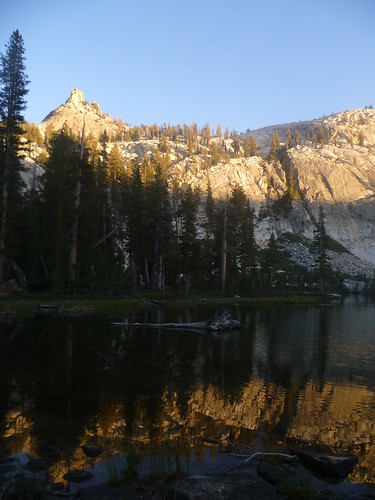
We bunked down that night using a diamond pitch again. Again there was no dew at all. Brian and Lizza used a shaped tarp with 2 center support poles. It looked kinda nice, but kinda bad for snuggling.
Day 3
Next morning we all went for a swim in the chilly lake and then hiked back to the cars... Beautiful trip. We had seen a fair number of other people up there, but they were all friendly. And there was no-one else at the last lake we went to. Generally there were 1 to 2 other groups at each lake.
Brian was very low on gas, so we followed him at first. We came up on a couple of four-wheelers re-inflating their tires for normal roads and reorganizing gear. Brian asked if he could borrow some gas and the guy gave him 5 gallons - said to pass the favor on when it came up. Sometimes, people are just awesome. We'd been talking about how to siphon gas off the Toyota into his car, or about driving out and coming back with gas.
Our two groups parted ways at the end of the ruddy little back-road, saying we'd have to do something similar again soon.
One last note. Jess carried her heavy as hell boots the entire trip, wearing the 5-fingers the whole time. She had them in case of cold weather - and it DID get cold, but only at night. We really need a 5-finger style shoe that works with insulating socks. In other words... moccasins. We're going to try making our own as soon as we can get our hands on Vibram souls - our huaraches experiments have taught us that leather wears out too fast on pavement.
Making an arrowhead
2010-10-17
--- I wrote this a while ago, but never got around to publishing it.
I think most outdoors nuts have heard of flint knapping.
When I was a kid I got into archery. Jess and I picked up the book "Naked into the wilderness" which had directions to make a bow and arrows starting from a dead deer, a tree, and some rocks. We also realized in reading this book that a huge portion of bush-craft is dependent on the hide and sinew from relatively large game. This inspired me to pick it up again with an eye towards getting good enough to hunt.
So, last weekend I was at the "earth dance" festival most proximal to San Francisco - and someone was teaching flint knapping! Awesome.
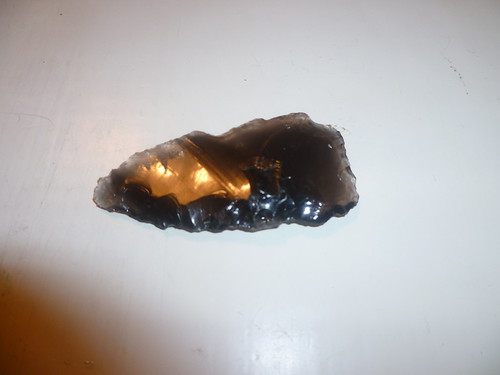
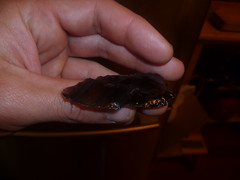
Flint Knapping, for those who don't know, is the process by which you turn a certain type of rock into a sharp cutting/piercing tool (such as an arrowhead).
The idea is simple. You strike a rock and it breaks. Certain types of rocks are very consistent, and don't contain structures that constrain the angles they will break at. Examples of this are cherts and obsidian. With these rocks exactly how you strike the rock, and what other forces you are putting on it at the time let you decide (largely) where it breaks. Thus, with repeated breaks you can slowly shape a tool.
This is one hell of an art. The guy who was teaching could fairly deterministically make an arrowhead in just a few minutes. It took me 4 attempts, and probably as many hours. The first 3 I cracked in half half-way through the process. And that's not counting the rocks I struck once or twice and gave up on.
Relevent facts are:
1) the rock breaks at ~120 angle from the angle at which you strike it
2) it's easier to transfer energy if the striking surface is rough, so the striker catches. Also, if the edge just cracks off it won't transfer energy deeper into the piece. So if you want to take a shard off that goes a long way across the piece, you have to strike a blunt face.
3) an arrowhead needs to be quit thin to slip between the two halves of a shaft for binding
4) making something thin is the hardest part, so that's your first priority. Shaping is easier
5) don't cut yourself! the edges are REALLY sharp
So, first, find your rock to make the arrowhead out of. You'll also want a rock to strike with, a round riverstone, sandstone rock about the size of your first works well. You can also use a lump of solid copper, or a chunk of bone.
That's basically it. With that in mind, you hold the rock with a piece of decently thick leather. Start with a larger piece and find a nice flat face to take a shard of, this shard will be the arrowhead. Next find a blunt face that points 120 degrees or so off from this. Take a rough rock and rub the second face to make a good striking surface. Place the first face against your thigh, on top of the leather. You'll want to be sitting on something, and not cross-legged, so your leg is solid. Strike the blunt face. It's easiest to strike with a wrist motion. You want a strike on the edge of the face, with a follow-through, you're looking to crack a long thin chunk off the bottom of the rock - not split it in half. Hit it lighter rather than heavier - you'd rather do nothing than split the entire rock in half.
This is one of 2 types of flaking. I just described strike-flaking. The other type is pressure flaking. It works exactly the same as strike-flaking, except that instead of striking, you just push really hard on the point you'd strike. This takes a lot of force, so it only works well once your piece is small, and you're taking off small pieces.
Hopefully you get a long thin slice off the back of the rock. If you're really lucky it'll be very nearly the shape of an arrowhead already. Most likely it will still require some shaping.
You may notice that you no longer have a good face to strike again (if you got it to break right). What you can do now is crunch the edges down, by just snapping then off, or by taking shallower flakes, until you have a better shape to flake against at all. You'll want to roughen the edges regularly as you go so you can get purchase for the flaking. Using this process slowly create the shape of an arrowhead.
Note that the hardest part is making it sufficiently thin. At the same time you don't want the whole thing *really* thin, or it'll just shatter. Because of this the most desirable break, what you're always trying to do, is get a long-thin flake off, since this lets you carefully control the resulting thickness.
That's really all there is too it! The rest is practice and skill. After about 4 hours, and shattering as many half-made arrowheads (and several more rocks earlier in the process), I got something that's pretty-much an arrowhead. As you can see I didn't quite finish flaking out notches to bind it to an arrow, but that wouldn't be that hard.