

Mendocino, First foraging attempt
2010-09-10
So, Jess and I decided that it was time to go out and try some of the skills we've been working on. In particular, we went out for the weekend with the intent of foraging as much of our food as possible.
First, the "meat". Things we tried and goodness factor:
Foods
-
Manzanita berry oatmeal:
-
Delicious: Crush berries, remove the seeds, add to oatmeal.
-
Delicious: Crush berries, remove the seeds, add to oatmeal.
-
Manzanita berry drink:
-
not bad: boiled the seeds from the berries and drank the water. It came out weak
-
not bad: boiled the seeds from the berries and drank the water. It came out weak
-
Manzanita ash cakes:
-
Delicious: Crush berries, remove seeds, mix with flour and wanter, cook in the fire
-
Delicious: Crush berries, remove seeds, mix with flour and wanter, cook in the fire
-
Fennel and Pine-needle couscous:
-
Pretty good: Make pine-needle tea, Cook couscous using this water, add lots of fennel, and some veggies.
-
Pretty good: Make pine-needle tea, Cook couscous using this water, add lots of fennel, and some veggies.
-
Milk Weed Pods:
-
Delicious: Young milk-weed pods, remove husks, eat raw and boiled and added to the couscous
-
Delicious: Young milk-weed pods, remove husks, eat raw and boiled and added to the couscous
-
Cat Tail Stalk:
-
Good: take the base of fat stalks, remove most layers, boil, remove more layers until it seems like food. Comes out a little slimey, and smaller than one might hope, but was pretty good in the couscous.
-
Good: take the base of fat stalks, remove most layers, boil, remove more layers until it seems like food. Comes out a little slimey, and smaller than one might hope, but was pretty good in the couscous.
-
Cat Tail Root:
-
side-shoots:
-
meh: Boiled and sucked on. These were kinda like eating glue. That said, it was food, just flavorless.
-
meh: Boiled and sucked on. These were kinda like eating glue. That said, it was food, just flavorless.
-
new growth:
-
pretty good: boil, peel and eat.


The first night, surprisingly, it was relatively chilly. We really hadn't been expecting this; I'd brought nylon pants, a canvas shirt, and a wool t-shirt. Jess had linen pants and a lighter (though heavy) cotton overshirt. We slept well enough though. It looked almost like rain all night; the clouds were really incredible (no photos, sorry).
Hunters
Before bed we went down to the river and discovered it was dry. Just down river though, it joins an outlet from the reservoir, so we figured that'd be wet. We walked down there and filled up a few water bottles. On the way we saw a light, and dodged it to the other side of the bridge. While gathering the water we could hear voices, so wandered around to say hi.The camp consisted o a group of men. They had a couple of pickups and were wearing camo. One had a gun slung over his shoulder, another had a light he was shining up at the hillside. They didn't respond for a while as we walked up, making us a bit nervous. Eventually they did respond to our hails. We asked if they were here hunting, they said no, but that they were going to go hunting on the other side of the river tomorrow. They were still being oddly cagey. As we walked away we realized they were spotlighting deer, or possibly elk (there are a lot of elk on that particular hillside). They seemed like a friendly crew though, and not any danger (I'd rather have cagey spot-lighters around than someone who might shoot me by accident.)
Gathering
Next day we packed up our gear, with all our books, and walked down the river. We headed for an area we'd been in before where there was some decent foraging. We dropped some of our gear there and went off looking for good stuffs. We tried carrying sticks for opportunistic hunting of birds and lizards, but didn't get anything that way. The season is late now, so there wasn't that much. There were tons of manzanita though, many in full fruit. The berries were older and no longer sticky, but still tasty.We got a number of milkweed pods. They're a very different variety than listed in our book. The poison quantities vary between verities, but all are low enough for even decent amounts to be eaten, according to our books. We'd discovered the last time we tried milkweed that the poison is a relatively strong and distasteful flavor. The poison can also supposedly be largely neutralized by a large amount of boiling, so we figured we'd boil it as much as needed. Upon tasting though it was pretty good even raw - though the pods we got (about 2-3 inches in length), we're on the old end of edible.
At our intended campsite we found some thistle, but it was dead, so no good shoots, and the roots were small (wrong variety). We dropped a bunch of our gear here and cooked some oatmeal with manzanita for breakfast on the wood-stove. We were near an old rope-swing, and as we ate our oatmeal some ATVs were going back and forth on the other side of the river. After breakfast we went to gather more food.
The cattail was hard to dig up from the muck, but pretty easy from deeper in the water. It was a small batch of cattail though, and we don't want to hurt the population, so we only took like 4 plants or so. A lot of the roots split while removing them from the muck. This meant they filled with muck that was between hard and impossible to get out, so we ended up discarding a fair amount.
Our books claimed that the root of lupine is pretty good, and we knew where some grew, so we headed there. It was growing in what amounts to rocks with a bit of sand in between. After a while of digging we'd gotten about 5 inches down, with no sign of anything looking edible. The root was still woody, looking just like a tree root. So we gave up on that one.
Gear disappears
We went back to our campsite and found... our gear was missing. Jess had lost her pack, cookset and sleepingbag. I'd lost my cookset and sleepingbag. We still had Jess' bearsack full of food, and a 2-liter soda-bottle, that's it. All gold this is several hundred dollars worth of gear (luckily we had the cheap sleepingbags, so it wasn't in the thousands.) Worse than that though, we had no way to stay warm while sleeping. We hadn't really gone out with the intent to try and survive in debris shelters, and eat food with no cookpot... so we headed for the car.We were fuming on our way out, who would walk off with our gear? We'd carefully laid it out in a manner such that it would look like it was left intentionally. Most of it was even clean-looking. It must've been obvious that this person was stranding us without sleepingbags. We stopped by the hunters camp on the way, to ask if they'd seen the pack... They hadn't. When We got back to the car, I started fiddling with things (getting car-keys and such), and munching on some salami and corn-nuts while we tried to figure out what to do. Jess, on a feeling, waved down some people who were driving by in a pickup and asked if they'd seen our her pack. By some incredibly strange circumstance, they had.
They described the backpack as being right next to where we'd left it, but on the other side of the river, and hidden in some bushes. We figured we wanted to get there ASAP, so we hopped in the car and drove down the road and onto a smaller dirt road following the river. We passed a car that had clearly been beaten with bats and shot up as target practice, making us a bit more cautious. We stopped not long after at a spot that we thought might be near our goal, and went down a trail. On the floodplain we found ourselves in a camping area, just across the river from where we'd left our gear. There were a couple of groups there. One group had 2 ATVs, the ones we'd seen earlier. As we walked down to the river towards that spot one guy on an ATV stopped and said "Oh, are you looking for your backpack? I put it to the side of the trail."
It was exactly where the other people had described it, with all of our gear (modulo a BIC lighter). It did appear to have been hidden under the bushes... and not with the apparent intent of making it easy to find.
Car Camping
Anyway, we walked away with the gear, happy to have it. When we got to the car though. We weren't feeling great about that area, and decided to go elsewhere. We drove north a ways up around the lake. It was getting late'ish, and we were at a small campground and decided we should just car-camp there. The caretaker was a neat older man with a super-cute pudgy little dog that "was his daughters". Of course, there was also a rock with his and the dog's name painted on it :P - clearly his dog. Anyway, we happened to score the best place in the campground. The caretaker called it "boardwalk", and the one next to it "parkplace", and said that he often got a list of people waiting to get into those spots when someone left.We lit a fire and tried all our food, sleeping in established sites is rough without pads due to the packed ground. We hadn't been planning that so had none. We slept okay - using one bag as a blanket and one under us (since I'd been cold the previous night, and my bag was less warm than Jess'). The next day we ate ash-cakes for breakfast, then walked a bit on the edge of the lake and just chilled out. Beautiful spot.
Not the trip we planned, but it all worked out fine.
Photos: http://www.flickr.com/photos/smalladventures/sets/72157625184464218/
Appalachian Trail Gear Weights.
2010-09-02
I realized today that I'd never posted this. It's just a spreadsheet with the weight of every item I was carrying when I got off of the Appalachian trail in Massachusetts, after 1500 miles from Georgia.
Sometimes it can be very educational to look at another person's gear list and compare your weights to theirs. Often you'll find that a different set of items is heavy (or even carried), thus comparing can help you realize gear you don't need (and they don't need :P), and what gear it's possible to replace with lighter stuff - if you so desire.
End of AT weights
Note that this is just what I happened to end up with at the end. I had actually stopped trying to keep my pack weight WAY down by this point (note that I was carrying a large steal handled hatchet that I found :P). I'm in no way saying this gear is what you *should* have, or any such thing.
As a side-note, I carried gear that I believed was sufficient for the entire trail, modulo replacement due to wear (including the white mountains and Maine). So the weights of a few items may be surprising for the southern end of the AT, especially to summer ultra-lighters.
In any case, I thought other's might like to see it. Enjoy!
Swimming a river
2010-07-30
Jess and I went on another trip up to Mendocino.
This time, after sleeping in a field Friday night, we drove down to the intersection of 18N25B and 18N25. We decided we should see if we could get to snow mountain - which we'd been eye'ing the last two times we went to mendocino.
We also realized on this trip that we really didn't need much. Both of us recently picked up new backpacks for work and dayhikes.

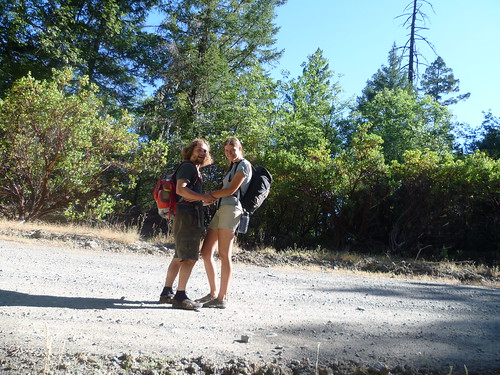
As you can see, they're not big packs. Jess' is 23L Mine is 25L. These are photos from our actual hike, so that's all our gear right there :P.
I had:
- basic med kit
- basic emergency/directional gear (knife, sighting compass, headlamp, etc.)
- sleepingbag
- cook-kit: pot, woodstove, bandana, spork, lighter (and alcohol stove, forgot to take it out)
- heavy overshirt
- nylon pant
- clothes on my back (t-shirt, shorts, boxers, giant heavy leather belt)
- bandana
- car-keys/wallet... at least part of the time
- map
So, we struck out Down a streambed. We tried milkweed on the way. It appears that some types are poisonous and some are not. I just this minute learned that common milkweed (an edible variety) only grows on the east coast. You can tell by the taste though. This seemed semi-edible, but not in large quantities.
Eventually we hit a river/corner of the lake. So, after some repacking in drysacks... we swam across. After wandering around a bit we realized the scrub in that area was not good for bushwhacking (something we were keenly aware of after our last 2 trips to Mendocino).
So, we swam back across, ate some food. While we were eating we heard some sort of party down the river. So we then began working our way downriver, walking on the sides, towards the lake, crossing as needed (I lost track of how many times). The sides were steep and in areas there was quite a lot of wild-rice.
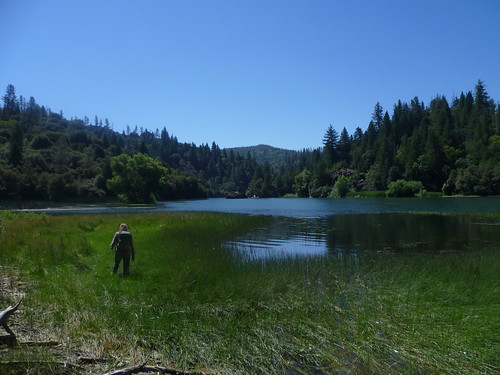
(note, this is actually a picture from our way back, crossing an inlet)
Around a sharp right and then as sharp left there was a large rock in the middle of the river, around this rock were gathered boats. They were playing loud music, people swimming, kids jumping off the rock, etc. We walked out and talked to a couple of people - apparently it's a weekly event.

The river/lake is wider here, maybe a couple hundred meters across. So, after some consideration we picked a path and swam across. Jess got pretty tired dragging her pack. All our gear was in dry-sacks, so the packs floated, but we'd already swam the river several times, so were tired. As you swim the pack slowly fills with water and gets heavier - so you slow down as you go.
After a good break, we struck off up the hill, following more dear-trails. It was tougher going, but not terrible. There wasn't much to sight off of, and both of us were getting tired, it was getting towards evening and we didn't want to be doing this in the dark. We had a decent idea where we were, but not perfect, and we wanted the fastest way back to water (I had 2 liter capacity, jess 3, and we weren't loaded up, so a dry-camp would've been iffy). So... we picked a drainage and started heading down. Eventually we found a nice bit of lake, got some water, ate dinner up on the hill, and crashed... hard.
Just before going to sleep I realized I didn't have my wallet. After some considerable consternation and looking around, I left my wallet, with the zipcar key, on a beach just before we swam the river. I had been wonderfully contented, but now I was a bit more on edge, anxious and double-checking over and over where I might've left it. I figured out eventually that I definitely hadn't had it when I repacked on the far side of the river, and I didn't think I had it on the rock-bar when we ate lunch, before I repacked to go down the river. So that's where it *probably* was.
During the night we kept hearing deer. One in particular was really pissed off about us, I'd intentionally urinated near the ur-sack (soft bear canister), knowing that bears in this area are afraid of people. It seemed the deer came apon this (about 20 feet from us) and was VERY upset that it's planned route onto the point had been cut off. I spent maybe half an hour making annoyed noises.
Next morning we did a bit of scouting and quickly figured out where we were based on the map. We wanted to get back to where I thought the car-keys were. After looking at the lake we realized going down the edge of it wouldn't be easy, and the forests up near the tops of the hills where we were seemed pretty clear. So we struck off down the ridgeline, following the edge of the lake.
This tactic turned out to be VERY successful. We had a couple of dead-ends. It turns out that if you watch where the major deer trails go it tells you a lot about the surrounding geography. Deer don't like to go straight down cliffs (though... what they think of a cliff is a LOT steeper than what most people think of as a cliff). They *do* disappear straight into dense brush though. Keeping these in mind you can look out at the surrounding land and guess based on texture, and where the deertrails are going, which way will be most passable.
In not long at all we reached the rock again, and swam back across. Here we met some people on a boat, who offered us a ride back down to our rock-bar. Not relishing walking/swimming back up the river (and wanting to get to the keys and see if they were there), we accepted. The family had built their own house near the lake apparently about a year ago. They said that mendocino was much wetter this year, and that the area where we first swam was normally "dry" this time of year (I took this to mean, very low, impassable by boat). This explained why no boats had been up there when we first swam the river - the boats weren't used to going up there due to the normally shallow water.
They got very worried about snags (only a 18" draft apparently on the motorboat, so not TOO worried) after seeing a few, so the dropped us off not far from the bar, and we swam the river one more time - it's only ~70m or so across here though, and only a portion of that deep enough to require swimming. So, in short order, we were back on the rock-bar.
And low and behold, the car keys!!!
Relaxed, contented, and happy, we napped on the bar for a while, then hiked back up to the car :). YAY!
The hike back was AMAZING. On the way down we'd missed a lot of the prettiest parts of the stream. A lot of it was almost like being in the jungle, just beutiful. It was all beautifully lush and full of life.
The rest of the photos are here http://www.flickr.com/photos/smalladventures/sets/72157624494623747/
review: bushbuddy woodstove
2010-06-16
Jess and are huge proponents of simplicity. The simpler something is, the less ways it can break and the more likely it is we can fix it. So, we've always preferred alcohol stoves for everything but the coldest weather, where the BTU/sec of alcohol is frustratingly slow for melting snow.
In the interest of trying to carry less, particularly less consumables, and detaching ourselves from the bonds to society consumables bring; we've done a lot more cooking on simple open fires lately. It turns out it's really quite easy, though it takes some time to build up a good hot fire that you can really cook on. The big downside is that you need to build up a fire-ring, you burn a lot more wood than you need to for the heat, and that ash is going to stick around when you're done violating "leave no trace". None the less, it's entirely viable in many situations where there are very few users, you have time (both for cooking and burial of ash), and/or you're camping in established sites.
Other times it's completely out due to limitations of fire hazards and such.
So, what do you do the rest of the time? Why are we carrying in fuel when there's perfectly good wood in many scenerios? The idea of being completely detaching from society is right there, but we can't because of time and environmental influence, what can we do about this?
Enter wood stoves. If we can burn wood really efficiently and completely we'll only need a few twigs, and the result will only be a tiny bit of ash. In many situations this won't cause anyone problems at all. Additionally, in so doing we don't need to wait to build up this huge mass of hot coals, because we're getting all of the heat out of the wood fast.
After a fair amount of research I picked up a
Bushbuddy Ultra
. More information can also be found on
BacpackingLight
. These sites together have give a lot of details, but the long and short of it is a 5.1 ounce stove with a double-wall firebox, an absolutely perfect draft, that won't scorch the ground. I ordered it with the matching titanium pot from backpacking light.

There are many woodstoves out there, and I haven't tried others. That said, the guy who desgined the bushbuddy is a tinkerer. He lives off the grid and spotwelds these by hand with a solar-powered welder and a home-made tip he developed himself. He's been perfecting the design for many years, and it shows. Additionally, the non-scorching feature is pretty rare and hard to find, this isn't something many of the stoves worry about, and those that do mostly don't supply sufficient heat isolation to achieve it.
So, the obvious question now is... how well does it work?
Well... wonderfully! Given a couple of sticks as long as your arm and as big around as my pinky (I have largish hands), along with some good dry grass or similar to get it lit, I can boil a liter of water in about 10 minutes best case. At worst it may take more like 20 minutes to get it all lit and the water to a hard boil. So far we've mostly used dry manzanita and live oak brush. This is some of the best wood you could have. The worst conditions we've used it in is a dewy morning. So we'll have to report back later with more thorough results.
With a stove like this there's no reason not to
really
cook your food. Even with those 2 sticks much of the wood used is in getting it up to heat, once it's hot getting a rolling boil is very fast. I'm sure that I can simmer on it with more skill, but I'm still working on that :). So far I'm still carrying my alcohol stove (at a cost of some fraction of an ounce). This means I can use the alcohol if I just want food "now" or can't find wood. The alcohol stove fits in the top of the wood stove for storage, and in fact the wood-stove acts like a super-fancy perfectly drafting high-tech windscreen, greatly improving the efficiency of the alcohol stove (sorry, I don't have numbers on that yet).
So, now that I've raved, what are the downsides. Well, the downsides are as obvious as the upsides. Although this is FAR easier than getting an open fire lit, it's still a heck of a lot harder than an alcohol or butane. You need good tinder. Surprisingly, supposedly you do not need very good wood. I've successfully boiled water using twigs from small dead brush, and I've heard you can use worse. The stove is very well built, and very robust under expected forces. That said it MUST be protected in your pack, the outer walls are extremely crushable sideways (not in the way your pot will put force). I expect it to last for many years, but I'm very glad I got the pot to store it in. Another downside you might expect (though not think of), unlike an open fire you're not going to be doing any baking in the coals. The biggest downside is the pricetag of $145. Handcrafted and designed by someone this meticulous it's worth it, but it 'aint cheap.
Jess plans to try her own designs and compare them to the bushbuddy, expect upcoming articles on the results of those experiments :)
Minimalist footwear (5-fingers, huaraches, and boots)
2010-06-11
There has been a lot of movement in popular culture towards more minimal footwear. This has made Jess and I very happy as it's given a lot more options for us. Admittedly it's slightly annoying since it's also created a lot of things that
appear
minimal, but really aren't.
Here's my story:
I in highschool I ran cross-country and track, and, like so many, I a lot of shin-splint problems. I really got into backpacking around the same time, and discovered that the outside of my right foot always hurt when I walked a long distance. As it turns out my arch goes all of the way across my right foot. A little odd, but everyone has something. In college my knees started causing me enough trouble that I could barely run at all. My girlfriend at the time noticed that I walked and ran duck-footed (feet pointed outwards). I had no apparent bio-mechanical issue (I hoped), so I did some research and retrained myself to walk with my feet pointed forwards. This also involved changing my normal spine alignment and basically my entire posture. I also training myself to run toe/forefoot strike style. The toe-strike running solved my shin-splint problems, which (as I discovered after a 50-mile day and subsequent hospital visit) turned out not to be bone fractures at all, but were actually a complaining overstressed tendon.While learning to toe-strike, I read that you should practice bearfoot running to improve your running form so it's less damaging to your joints (it hurts if you do it wrong barefoot). I started running barefoot and it felt good. I figured maybe I didn't need shoes and got up to running 2 miles or so barefoot. Then one time I hit bad rocks on a sidewalk and got blood blisters deep in my heal. At that point I realized my feet couldn't easily get tough enough for barefoot running anywhere, and I did in fact need shoes. I also realized around this time that cherts (the stone) exist in many places, and can be razor-sharp. No matter what, shoes will take that better than my foot.
I needed footware.
Okay, but what KIND of footware? By this time I had found that the higher the heal on my shoe when running toe-strike, the less well I could run. In my experimentation I had also discovered that if I ran in a non-supportive shoe and then hiked in the same shoe, my feet hurt far less than if I ran in a supportive shoe and then hiked in that same shoe. Basically, my feet were better at taking the force than the shoes were - if I gave my feet practice.
So, ever since then I've been on the hunt for thin-soled non-supportive shoes without extra "features" that add weight, and make a natural stride less comfortable. In the process I have discovered numerous other advantages. For example the lower the heal on the shoe, the harder it is to roll your ankle, and the less material in the shoe, the faster it dries.
The Shoes
Trail Racers
The first type of shoe I discovered was the trail racing shoe. Trail racing shoes, as it turns out, come in quite a wide variety. As the "minimal" thing got popular a lot of not-at-all-minimal shoes started getting marketed as minimal lightweight trail-racers. I didn't like those, I liked the ones with almost nothing - like this: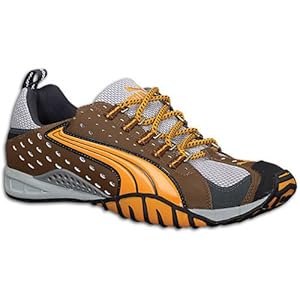
I've had a few pairs that were even more minimal, but those shoes always got more "shoe" added in the next model year, these are the best I've found that have lasted any time. I also tried road-races, but I found that they wear out a bit too fast.
Leather Boots
Jess wears mostly high-ankle leather boots, similar to older forest combat-boots (I haven't found any that fit me well yet), kind of like this:
The key is that both of these solutions have a wide sole so they are stable, little to no padding to absorb water, a flexible ankle to aid in natural stride, and NOTHING ELSE. The leather boots are heavier, but last longer and shed water better.
Either of these solutions can be used in cold weather with the addition of waterproof socks
 , and warm socks.
5-fingers
Jess, myself, and several of our friends have been wearing 5-fingers regularly for a while:
Overall we find they're like being barefoot. The downsides: they stink after a while (you can wash them, and wearing toe-socks helps), and the cloth on top wears out too fast. A friend at work found that the KSOs are worse than other models and theorizes that its due to added tension of the upper. In any case, they seem to wear out, and they are not cheap. The upsides: Jess and I have both actually backpacked in these (though on shorter-distance trips) and found it to work extremely well even on rock. The only issue is that the ball of your foot has to be a little tough. They are absolutely attached to your foot, and get incredible traction. As a result 5-fingers are awesome for running, parkour, rock scrambling and hiking. I'm a pretty big fan overall, but expect to spend some moeny.
Huaraches

Recently I was talking to someone who pointed me at this website: http://www.invisibleshoe.com/ . This site describes how to make Huaraches. Well, we had some decent chap leather in the house, and some twine. So Jess and I immediatly made pairs of our own... and we love them!
I'm wearing them now. I've been wearing them to work a lot lately, and find them great for work and city use. Jess and I have also now both worn them for some miles while backpacking. Jess loved them even for backpacking. I found them to work *okay* but they picked up a lot of rocks. Our feet got sore of course, as they're still toughening up, but they protect you from bad thorns and sharp rocks. Basically, imagine a super-light teva sandal you can make at home for no money, with an ultra-flexible soul that pretty much stays perfectly on your foot through a normal step. The other downside (besides the rocks) is that when you do slide on the sole, the ropes can be a bit uncomfortable; though, this only happens when on very steep hills and in certain types of mud. We had no problems bushwhacking down river-beds (and didn't need to care about our feet getting wet).